Sunday, April 29, 2012

Day 2, Rosenborg Castle

The pictures of my second day in Copenhagen are rather heavy on my first stop, Rosenborg Castle, so I decided to give it its own entry.

In my last post I mentioned that there are several castles in the city, and the one I described last time is the current royal residence, dating from the eighteenth century.

This one coming up is the oldest remaining one in Copenhagen, Rosenborg Castle, and it was built sometime during the Renaissance.  There was VERY little information in English and my other language skills failed me so I don't have a lot to tell about it.

Anyway, although I had done a lot of research on the public transportation system in the city (which, by the way, seems very good) I ended up walking everywhere just to enjoy the city.  Friday was absolutely gorgeous in Copenhagen, which took me by surprise - I was expecting a lot of cold, damp, broody weather but Friday was like any other non-rainy spring day in Paris.  Hooray!

On the way I just had to take a picture of this little street because it reminded me so much of my Brooklyn neighborhood:


I wandered through the "Latin Quarter," an older part of the city where the University of Copenhagen still is.  I always feel at home in these areas because university students are the same everywhere - hauling around large backpacks, standing around in groups to chat, riding bikes recklessly, setting up their laptops in cheap cafes.  This area was even filled with narrow, cobblestone-y streets like the Paris Latin Quarter.

The castle and its gardens are just north of the university, and the grounds are quite pretty.  Or at least, I imagine they would be when things are blooming; for now they're a bit dreary but with potential.


When this building came into view I thought surely it was some kind of other thing associated with the castle but not it...it seemed so, I don't know, small?  Not small exactly because it's really big, but when I think of Renaissance palace I don't think of this.  Evidence I've been in France too long, I guess, because I suppose I was expecting a chateau.


In any case, that was the palace.

A lot of the rooms are more or less as the kings and queens left them - lots of kings named Frederick and Christian, but I know next to nothing about Danish royalty (apart from Hamlet of course!). 

But I had a lot of trouble figuring out what was what exactly.  Like this, I could see that it was Christian something's bloodstained bedclothes but why were they bloody?  Why are they on display?  Wikipedia is not helpful in this case.


Old toilet rooms are always kind of funny to see.  You imagine the kings and queens back then had every possible comfort, but this is still where they had to go.


When I said last time that Denmark's monarchy seemed to have avoided the super overly ornate French-style decorating, I guess I spoke too soon.


I decided I want this silver set for my everyday toilette.  Birthday present, anyone?


There were two kinds of ceilings here - this, the older kind, which is more unusual in Western Europe, with the square panels - and the typical one with a central fresco and molding around that.


There were all these tiny little side rooms that would say they're the bronze cabinet, or glass, mirror, porcelain or whatever, and they were all filled to the brim with treasures that I suppose the royal family accumulated over the years.  The pictures only show portions of one wall, usually, but imagine there is a whole closet with shelves filled like this, to the ceiling.

Bronze:


Glass:


Porcelain:


Eventually I came to the throne room, which I have to say is probably the most impressive one I've seen.

Hey look, there's me in the mirror!


The king and queen's throne.  The king's, left, is made of narwhal tusk!


And obviously any competent king knows his throne should be guarded by solid silver lions:


In the basement part of this castle is the royal treasury.  In olden times the treasury consisted of all the precious jewels and other objects owned by the king's family, passed through the generations.  Often it was kept in a strong room in the main residence, but I know that, for example, in 11th and 12th century England it was hauled along with the queen wherever she was going and protected somewhere near her bedroom.  If the crown was desperately in need of money they could sell off pieces from the treasury.

Today obviously the treasury is part of Denmark's national heritage so it's not going anywhere.  I suppose the only pieces that are ever brought out sometimes are the crowns for ceremonies of state, but even then - the Danish monarchs don't even have coronation ceremonies so I'm not sure what types of events would require the queen to wear her crown.  Anyway, everything here is probably priceless.

This is the ceremonial sword:


A goblet I liked for obvious reasons:


The official crown - there were two other (more casual?) crowns but this one is the one designated for those mysterious non-coronation crownworthy activities:


This picture is bad, but these are all hair ornaments. WANT.


And the various items from when they used to have coronations - the orb, scepter, sword, etc.


By this point I was sort of worn out by royalty, so though I did visit the final castle on Friday I only went into the ruins underneath.  That and some other stuff next post.

Friday, April 27, 2012

Copenhagen, day 1, part 2

I left off the last post right after leaving the National Museum yesterday, headed towards the Amalienborg Palace. 

These two sites are pretty far away from each other, but I was pleased with walking across the whole main part of the city.  Walking is by far the best way to get to know a place quickly; getting lost is never so much fun as it is n a new city! 

Here are a few pictures I took along the way.

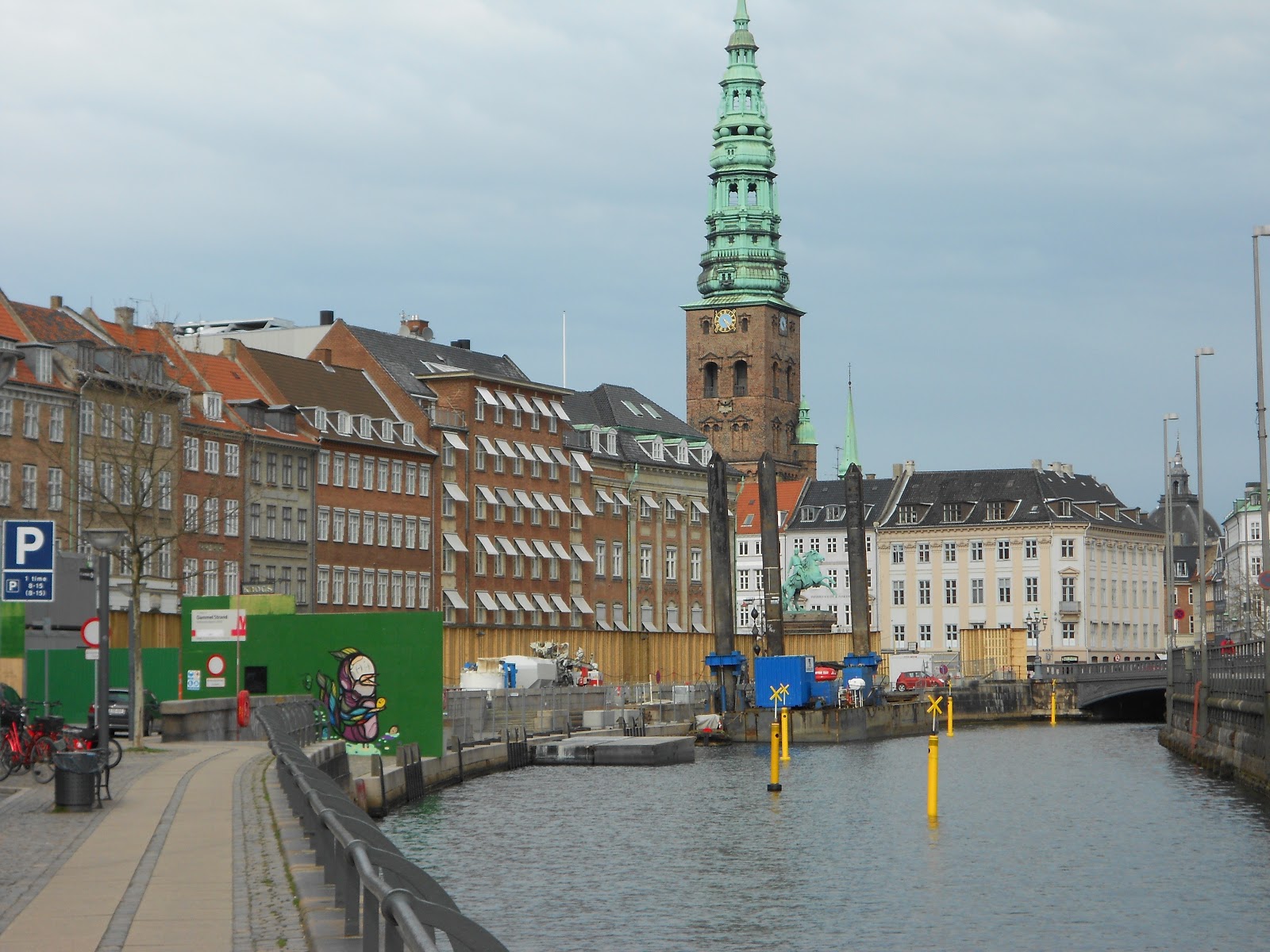
These buildings are the stable and carriage rooms of the original Christiansborg Palace, which used to be the main royal residence.  It was destroyed twice by fires in less than a hundred years - more on that next post.


The city really is lovely but there is construction everywhere.  It's been driving me nuts!


Here is a statue of Bishop Absolom, who strong armed a king into giving him a bunch of land and founded Copenhagen.  He sounds um...not very bishop-like from what I've heard.


No clue who this is but he's fun!


Note: this edifice is clearly a church.  A lying church, or one with an identity crisis.


After marching bravely through the scariest traffic areas of the city, I came to the area of the Amalienborg Palace.  Directly across the canal from it is the newish opera house.  It certainly lacks the panache of say, the Sydney Opera house, but it's still pretty cool. 


A close of view of the inside reveals that instead of the traditional chandeliers it has...disco balls?


And here we are finally at the palace!  Don't be fooled by that dome-y church in the background, it's not part of the palace complex.  Actually, it doesn't look much like a palace at all.  It's a series of four mansions, originally built for your average noble families.  The royal family appropriated it after their aforementioned other residence burned down.  Now the queen lives in one, the crown prince and his family in another, and two appear to be partial museums. 


Here it is seen from the canals.  It's hard to tell, but you can see a tiny flag flying above the one on the right.  Apparently that's the prince's residence, and the flag tells you he's home.


The royal guards, of course!  


By this time I was starting to get hungry again and picked out a place I was excited to try: for anyone not in the culinary know, the foodie world has been buzzing about the "new Nordic cuisine" for a few years now, and this was one of the less upscale places involved. And being that it was near an area I wanted to see I headed in that direction before dinner.

Now, this place is a bit hard to explain.

There is an autonomous "freetown" called Christiana within the city of Copenhagen.  It is not responsible to the city but to the state of Denmark, so therefore it has different laws and regulations.  It started out as an area covered by large military barracks, but they were moved out by 1971 and no one else was allowed to use the land.  People who lived nearby began to use it for a children's playground and some homeless also wandered into the area - I'm unclear on why, but this was done as a sort of government protest.  Naturally, hippies and artists were the ones who stayed there, and eventually the city kind of gave up and turned it over to them. 

After a rather short time the community in Christiania because mostly artists, musicians, hippies, and drug addicts (those categories often overlapping of course).  The former are still in residence, although so-called "hard drugs" have been removed from the area; the entire community seems steeped in pot culture, though, and because of its peculiar law system it's kind of unofficially allowed there.  They have their own set of "laws" even, including things like zero tolerance for any kind of violence, knives, or guns, no gang colors, collective ownership of the land and shops, its own currency, things like that.

Finally in 2004 the government began cracking down on the open and thriving hash trade in the area, so it's more secretive now - only in that they don't allow people to take pictures of the hash dealing zones.

Anyway!  I just had to visit, being that it's known for its artsy-ness, spontaneous music, and generally being laid back and hippie-like.  No cars, either.

I made my way down there and found it pretty easily, as this is the main entrance:


There are TONS of great examples of street art in this little collective.  Unfortunately I couldn't get that many pictures because lots of them are near the so called "green light zones," or the areas where they allow hash trade.  I got yelled at for taking pictures in those areas, but here is one of them.  Each of these little stands sells hash and pipes (some quite pretty) and things like that, in addition to other random stuff.


And just around the area:

This is the symbol of Christiania, and is on the "official" flag.


And as you leave at the main exit you see this:


It seems sketchy, and I'm sure many of you are doubtful of my fondness for the area.  But it's laid back, full of art and music, the people are nice and friendly, and there are lots of quirky shops and tourist sites.  I thought it was pretty awesome.

So the place I wanted to eat was nearby, almost in the middle of a park, but more importantly connected to this cool little 17th century windmill.


But it was closed! Ugh!

Unsure of what to do next I headed back towards the livelier part of the city, knowing there were some good restaurants.  I was starving by this time and getting a bit grumpy as I walked, but all of a sudden I heard and enthusiastic "Bonjour!" addressed in my direction.

I looked around, bewildered, since I don't know anyone, much less any French people, in Denmark.  It was the guy I met on the train the day before!  Talk about strange.

We chatted a bit again and I thought that chance meeting so serendipitous, being that he was in search of dinner too, I wondered if I should suggest we eat together.  I didn't, though, and we parted ways with him suggesting we might run into each other today (we didn't).  Perhaps we'll take the same plane back tomorrow?

Anyway, I found a cute little place on the water and had a lovely dinner of asparagus and baked hake with mushrooms and new potatoes.  It was a great place for tourist-and-stupid-student watching, but after a while it got quite cold so I walked home.

I left the restaurant a bit after 8pm and the sun was nearly set by the time I was close to the hotel.  I'll leave you with a view of the Tivoli Gardens entrance at dusk:


More later, or tomorrow!

Copenhagen, Day 1

Oh hey, long time no see!  I'm back!  I will make my excuses, triumphant return, etc, later, because for now I want to get right to some of my recent adventures.

I am in Copenhagen, Denmark.  Hands of those who knew what country Copenhagen is in, and again if you could easily point it out on a map!  Denmark is in a bit of an interesting place geographically and culturally.  It's part of Scandanavia (along with more northern brethren Norway and Sweden), an area which refers to "historical cultural-linguistic affinities" amongst the countries (for those indignant on Finland and Iceland's behalf, I won't get into it too much but their "Scandanavian" characteristics came much later).  However, its only significant land border is with Germany and it does not share the same land mass as the other two.   It is a small peninsula jutting upward from the north of Germany along with a collection of islands nearby.  Copenhagen, the capital city, is itself a series of islands, and a mere 6 miles or so from Norway, separated by the sea.

So while historically Denmark certainly developed with "Scandanavian" characteristics in modern times it seems to be the least "Scandanavian" of the group.

Incidentally, I realized this was the first NEW country I've visited since going to Greece after freshman year of college (same trip as Turkey).

Anyway, all you guys really want to know is what I did and see pictures so let's get to it!

On the train into the city from the airport I had a conversation (in French) with a nice French guy who was in Copenhagen on business, and had never been before either.  His English was passable but my French was better so I helped him figure out some stuff and we chatted.  (This will become relevant later, is the only reason I mention it now.)

I had signed up for a hop-on hop-off tour today so I did that first thing, without hopping off anywhere.  One, it was rainy, two, the place I wanted to start walking was where the tour started and ended, three, the bus driver was really cute.  It was good to get a feel for the layout of the city, figure out which areas I wanted to visit later, and get some background.  I ended up going back to a few of the places today and will visit some more tomorrow.

One place from the tour I will not revisit, however, is the Little Mermaid statue.  You have probably seen pictures or heard of this statue: it commemorates the beloved tale by Hans Christian Anderson, and is probably the most famous image associated with Copenhagen.  The poor original mermaid, though, was decapitated and otherwise vandalized so the current one is a different mermaid by a different sculptor.  No wonder she looks so sad.


But there is nothing else to see around the statue, really; it's sitting on what is more or less a commercial dock/port.

When the tour ended I went over the the Tivoli Gardens, probably the most well-known attraction in the city.  I knew what it was generally, so I'm not sure what I was expecting but it wasn't quite this.  The Tivoli Gardens are less gardens than well...an amusement park I suppose.  Except not quite.  It is a park - not so much gardens - that has all kinds of amusements: fast rides, kids rides, pantomime theater, open air dramas, a music stage, a concert hall, light shows in the evening, a playground, tons of restaurants from hot dog carts to gourmet places, gift shops, and something that appears to be a theme hotel.

It was conceived in the mid 1800's, and the claim is that the designer wanted to distract people from political troubles by giving them all kinds of ways to entertain themselves.

The main entrance


One of the more commercial corners


The pantomime theater


One of the rides for kids, I think


There are roller coasters and things too but I couldn't get good pictures of any of the bigger rides.

Then I wandered over the the famous Anderson Bakery for a Danish hot dog and pastry.  There are a few things here that are indelible parts of the national cuisine, and I feel obligated to try them: beer, herring (prepared many ways, but smoked is a favorite), hot dogs, and various pastries.  They take hot dogs very seriously here.  The typical "Danish hot dog" is 100% pork, has ketchup and a distinctive mayo (a type of remoulade), very thinly sliced pickles, and tiny crispy fried onions.

So here is my beer, hot dog, and mini danish. 


Next stop was the National Museum, a place that, while it does have a ton of stuff on Denmark alone, also has extensive exhibits on other cultures.  It's really big so I stuck to the Danish stuff only.  It covered from pre-history, starting with the Stone Age, through the Viking period, the monarchy, and finally modern history.

They have a good number of bog people, ancient artifacts like weapons and tools, some clothing, archeological finds, etc.  I won't bore with most of the details, because I think probably what people are most interested to see, in terms of Danish history, is Viking stuff.

This is a poor picture but look!  Viking helmets!  Actually, these are from a period that is not really the Viking period, this is Bronze Age.  But you can see that they are predecessors to the stereotypical Viking helmet.


This looks like some sort of sculpture, but look closely and you can see it's a bunch of horns hanging together.  These are Iron Age instruments only found in Scandanavia.


 These are braids of hair cut off to show respect for their gods, or something of that nature.  The longer the braid offered, the more prestigious it was.  I don't know how close this would have been to the original hair color, being that these are probably around 3,000 years old, but I find the color interesting!  They would not have all come from the same person.


Here is a room just full of rune stones.  They are pretty cool.


Moving forward, there was another floor that focused on Danish history from about 1200-1650 or so.  This dealt with the rise of Christianity and the monarchy.  A lot of the stuff was very familiar, but I was struck by how different the Scandanavian religious art is compared with the Western European examples I normally see.  It's simpler in style and much less focused on pain and suffering, at least until a later period.  The early crucifixes, for example, have Jesus serenely watching over his people as king, rather than having him bloody and injured and near death.  If anyone is interested I can post some pictures but I won't at the moment. 

The museum is housed in an old royal palace, and they restored some of the eighteenth century apartments on the 3rd floor.  I wandered through those a bit, noting that the Danish monarchy clearly shied away from the extreme opulence and splendor of the French court of the same period.  Also the portraits show that the royal Danish women were rather unfortunate-looking.


Finally there was a section on "stories of Denmark, 1600-2000."  This was super interesting to me as a historian, as it tried to go through the daily life of Danish people in all parts of society, and analyze how it had changed over time.  Rural, village, urban, landed gentry, bourgeois, peasants, through four hundred years.  Very cool.

...Except when it got to the end, the very modern history.  It made me feel old!  Especially this one part of the exhibit on the 1990's, where I spied this PlayStation 2.  What!  In a museum!  I don't think I've ever felt quite so old.


Finally, done with the museum, I stopped by its cafe for some tea and promptly was given the biggest "tea mug" I've ever seen.  I don't think this perspective does it justice.


And that's all for tonight!  We're still only halfway through my day today.

Next time: my journey to the current royal palace, the royal guards, the independent city-within-a-city in the middle of Copenhagen, and dinner.