Showing posts with label Arrondissements. Show all posts

Friday, November 2, 2012

13th arr

Today we are headed into a really unknown (by tourists) area of Paris: the 13th arrondissement.  If you take another look at the map of the arrs, you'll see that the 13th is south and east of the 5th, where I live now.


The sad fact is, although I had so much to say about the 5th that it took two posts (and I still didn't fit it all in), I don't have nearly as much to say about the 13th.  This is particularly disheartening because it's where I lived when I was here in 2008!

As I said all the time back then, the northern part of the 13th is very residential, quiet, and frankly almost boring.  However there are a few things of note: the 13th is home to the extremely cool National Library and the only prison in Paris, which I lived next to last time and I wrote about once before.

The BNF (Bibliotheque Nationale de France, the National Library) is an almost brand new site and kind of interesting architecturally.  It mainly consists of four large towers (representing areas of learning: time, letters, law, and numbers) that are supposed to look like open books.  They don't, really, to me.  These pictures aren't mine.


Between them is a large, inaccessible courtyard, but underneath that there are more levels of the library.  Anyone can get a membership and study there (I'm a member of a different branch).

Two areas of the 13th are distinctive neighborhoods: there is Paris' Chinatown in the south/southeastern part (the only place to get good, authentic Chinese), and the Buttes aux Cailles, the only cute area in the arrondissement, which used to be a village to itself.

You get a lot of this type of thing in the 13th, as below: some late 19th/early 20th century buildings juxtaposed with quite moderns ones.


That's basically all I would remark on in the 13th.  But that's me; there is another person, long dead, who wrote a good deal about the 13th in his second most famous novel.  A good portion of Les Miserables is in fact set in the 13th, and Victor Hugo describes one particular area in some detail.

I was going to talk a bit about how the 13th is one of the newest areas of the city, and not so long ago it wasn't even considered part of Paris, but why would I do that when there is a much better writer to tell you about it?

Hugo was a native Parisian and although the scenes he's describing here were set between thirty and forty years before the novel was published (1862) he remembered the city as it was in meticulous detail.  By the mid 1800's the 13th had become more integrated into the city - as Hugo notes, a train station was built there in the 1840's and "wherever it is placed on the borders of a capital, a railway station is the death of a suburb and the birth of a city."*  

So I'm going to give you some quotes from Les Miserables describing the Place d'Italie area of the 13th, and show some modern pictures of the places he's talking about.  I'll try to edit him as best I can!

“[In 1823], a rambler who had ventured into that unknown country...reached a point where it might be said that Paris disappeared. It was no longer solitude, for there were passers-by; it was not the country, for there were houses and streets; it was not the city, for the streets had ruts like highways, and the grass grew in them; it was not a village, the houses were too lofty. What was it, then? It was an inhabited spot where there was no one; it was a desert place where there was some one; it was a boulevard of the great city, a street of Paris; more wild at night than the forest, more gloomy by day than a cemetery.”  

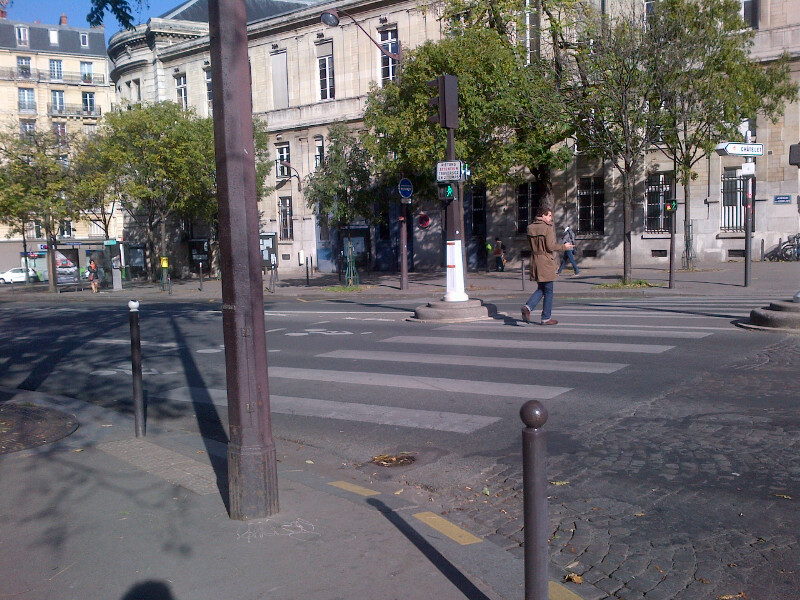
He's talking about going southwest down the Boulevard de l'Hopital; here are a couple shots from the walk I took based on his directions (these were taken on Sunday, which was very sunny!):


“The rambler, if he risked himself...after leaving on his right a garden protected by high walls; then a field in which tan-bark mills rose like gigantic beaver huts; then an enclosure encumbered with timber, with a heap of stumps, sawdust, and shavings...then a long, low, utterly dilapidated wall, with a little black door in mourning, laden with mosses, which were covered with flowers in the spring; then, in the most deserted spot, a frightful and decrepit building...this daring rambler would have reached little known latitudes at the corner of the Rue des Vignes-Saint-Marcel.”
 
Those "little known latitudes at the corner" are roughly here, just before you reach the Place d'Italie.  Now the Place d'Italie is one of those huge roundabouts, but at this time it was a "barrier," or a little station attached to low city walls, marking the official end point of the city.  As he says, it was a rather deserted area then called a suburb rather than actually part of Paris. Here is that corner today, first the corner itself then looking into the Place d'Italie.


After a lot of surveying the area and going over old names of roads I think this is where the house/"decrepit building" he refers to would have stood (funnily enough now a police station - in the book lots of crimes take place in the house):


 "Opposite this house, among the trees of the boulevard, rose a great elm which was three-quarters dead; almost directly facing it opens the Rue de la Barriere des Gobelins, a street then without houses, unpaved, planted with unhealthy trees, which was green or muddy according to the season, and which ended squarely in the exterior wall of Paris. An odor of copperas issued in puffs from the roofs of the neighboring factory."

The factory he mentions was one of the dyeing factories that served as part of the Gobelins manufacture, a large business that made tapestries and cloth.  The Gobelins had been functioning in that spot since the mid 1400's and had expanded to include large factories after the industrial revolution.  Parts of these factories are now museums.  Here is the modern Avenue des Gobelins (what he refers to as the "barriere des Gobelins) where it meets the Place d'Italie.

And one of the late 19th century factory buildings, which is now the main museum for the manufacture.


“this Place Saint-Jacques, which was, as it were, predestined, and which has always been horrible, probably the most mournful spot on that mournful boulevard...”

This is where he's talking about, across the roundabout from where we started.

 
This is now a large boulevard with a divider; where the divider meets the roundabout there is now a WWI monument to the fallen of the 13th - strange that it's there when he had described that exact intersection as "the most mournful." 


And now his overall impression of this neighborhood:


“The place was unpleasant. In addition to the gloomy thoughts which assailed one there, one was conscious of being between the Salpetriere [a hospital], a glimpse of whose dome could be seen, and Bicetre [an old prison just south of Paris], whose outskirts one was fairly touching; that is to say, between the madness of women [hospital] and the madness of men [prison]. As far as the eye could see, one could perceive nothing but the slaughterhouses, the city wall, and the fronts of a few factories, resembling barracks or monasteries; everywhere about stood hovels, rubbish, ancient walls blackened like cerecloths, new white walls like [funereal] winding-sheets; everywhere parallel rows of trees, buildings erected on a line, flat constructions, long, cold rows, and the melancholy sadness of right angles. Not an unevenness of the ground, not a caprice in the architecture, not a fold. The ensemble was glacial, regular, hideous. Nothing oppresses the heart like symmetry. It is because symmetry is ennui, and ennui is at the very foundation of grief. Despair yawns. Something more terrible than a hell where one suffers may be imagined, and that is a hell where one is bored. If such a hell existed, that bit of the Boulevard de l'Hopital might have formed the entrance to it.”


Depressing, no?  I thought the above pictures might be the modern version of what he's talking about.  I wouldn't currently describe it the way he does, but this area of Paris is certainly one of the ugliest, least creative, and - he's still right about this - symmetrical in the city.

Anyway, starting at that roundabout and going south and southeast is Chinatown, and that area certainly has a more interesting energy.  I wish I had pictures of Chinese New Year there because it's fun and awesome - they have a parade of dragons and lanterns, lots of people, food everywhere, and just cool stuff.

That about sums it up for the 13th; sorry it was a rather depressing description.  I don't mind the 13th particularly, it's just not that interesting to write about!

*All the quotes are from Volume II, book IV, chapter I of Les Miserables.  For those who know the story and might be wondering, this is where Valjean rented a house after adopting Cosette, and, years later, where Marius and the Thenardiers had rented rooms just before the uprising - the implication is that Valjean wanted to get lost in the vast population of unfortunates, while Marius and the Thenardiers were forced to live in such a terrible area because of their poverty.

Friday, October 26, 2012

12th arr

The 12th arrondissement is the easternmost area of the Right Bank of Paris.  It's split into a few distinct sections: immediately on the river is the Bercy area, which is mainly a very large park with a sports complex.  The park is very nice and peaceful; it's a more modern design than many in Paris.

These pictures aren't mine.


The park is connected to the 13th arr across the river by a footbridge.

Just north of the park is where most of the trains come into Paris, so there isn't much there but a jumble of train tracks and a couple of stations.

To the north of that and the eastern part of the 12th is mostly a business and residential area, there isn't much to see there.  Here is a rather nice fountain in the Place Felix Eboue, although it's sad looking at the moment, with no water.  Sometimes it's lit up and very pretty.


To the west the 12th meets the 11th at the Bastille, and it has a similar feel as I described for the 11th.  There are a lot of bars and restaurants, and it tends to be a middle class oriented area.  This side of the Bastille is a bit quieter and more staid, but it's one of my preferred neighborhoods: there are a lot of things to do but it's not hectic and too busy.

Just next to the Place de la Bastille is the Opera Bastille, the current home of the French National Opera.  This, rather than the famous opera house in the 8th, is where you would go to see an opera since the mid 20th century.  It's also a really cool building, and one of the few prominent examples of modern architecture in the city.


Moving along to the north side of the 12th there is the area around the Place de la Nation, the last of the huge roundabouts in this western portion of the Right Bank (the 10th, 11th, and 12th arrs).  This "star" joins ten large streets, and I think it's probably second in size only to the circle around the Arc de Triomphe.

It's hard to get a good picture of the center circle because there is so much traffic.


Here is an aerial shot of it, obviously not mine!


Nowadays it's mostly used for festivals and gatherings and such, but it was originally called "Place du Trone," or "the place of the throne" and had strong connections with the monarchy.  Louis XIV, the Sun King, came here after his marriage in 1660 with his new wife to sit on a throne before the people.

Under the Revolution it was renamed "Place du Trone Renverse," or "place of the backwards throne" as a bit of a joke, since a guillotine was placed there.  It was not the main guillotine in Paris, which was at the Place de la Concorde, but it still had a good amount of victims.

Near the Place de la Nation is the place where these victims were buried, now the Picpus Cemetery, but at the time it was an Augustinian convent that had been seized by the revolutionary government.

Today it's the only privately owned cemetery in the city, and possibly the one with the most modern burials, but you can visit it.  I'm going to write up a separate post on the cemetery because it turned out to be very interesting, but I'll give you a couple of pictures for now.

This is the site of the mass graves for the guillotine victims, who included commoners, clergy, nuns, members of the army, and nobility.


General Lafayette's wife was one of the main patronesses of this cemetery after the Revolution, so they are both buried here.  In deference to his role in the War for American Independence an American flag is always present above his grave.


So that's the 12th arr in a nutshell!  I highly recommend the Parc Bercy as a nice green spot away from touristy areas, and the banks of the river in the 12th are very pretty.  The Bastille area is fun and interesting, as I've mentioned, and I definitely recommend the Picpus Cemetery to any of my fellow history nerds - otherwise it's probably not that interesting.

Tuesday, October 16, 2012

11th arr

The 11th arrondissement lies just to the south of the 10th, and shares a lot of characteristics with the up-and-coming parts of that area.  The underground part of the Canal St Martin forms a wide boulevard, and around this there are a ton of trendy places to eat, drink, shop, be seen, etc.  To the west of the 11th is an area called Oberkampf that has a very "new Brooklyn" vibe with young people/student/hipster bars and shops; similarly around the Place de la Bastille farther south there are more cool, diverse restaurants and bars than you can count.  They range from cheap, greasy, quick Chinese to upscale tapas to new fusion French.  The rest of the southern area of the 11th is mostly residential, and this is where a lot of single young professionals live.  It's kind of the area to go when you have some money, but not a whole lot.

Anyway, I'm describing the atmosphere here because there is a dearth of monuments and things to see in the 11th.  There are two important "places" (in the French sense - meaning a circle/roundabout with significance): the Place de la Republique and the Place de la Bastille.

The Place de la Republique is actually on the border of the 3rd, 10th, and 11th arrondissements, and is the junction of seven roads - some huge boulevards and some smaller.  It's always had a great amount of political symbolism.  As is evident, it was made to commemorate the founding of the French Republic, and in the center is a statue of Marianne - the lady who is the embodiment of the Republic - surrounded by allegories of liberty, equality, and fraternity, the founding principles of the Republic. (picture of the statue from Wikipedia)


Back in the 1800's this area was largely working class, and when Paris was redesigned under Haussman many of the poorer people were pushed out.  But the city as a whole remembered the roots of this area, and the Place de la Republique became a meeting point for the socialist/communist/left-wing marches, parades, strikes, etc.  Politically based things that happen there to this day are usually all making a statement aligning themselves with the more radical ideas of republicanism.

Right now the whole circle is undergoing major construction to make it easier for pedestrians to get around, so poor Marianne looks like this for her own protection:


Secondly we have the Place de la Bastille - another name you'll probably recognize.  This was the former location of the Bastille prison fortress, where the famous "storming of the Bastille" took place (commemorated on July 14, "Bastille Day" to the non-French).  This was the moment many people point to as the start of the French Revolution, and most historians say was just the start of the violence of the Revolution.  Anyway, on July 14, 1789, Parisians were angry at the government and heard that troops were storing up ammunition and guns to be used against the people to quell recent unrest.  An angry mob (of less than a thousand people) broke into the Bastille - which at the time was only keeping seven old men prisoner - to take the weapons themselves.  The romantic legend goes that they wanted to free the political prisoners kept in the Bastille, since the fortress was a symbol of the state and the monarchy, but that was a secondary goal.

Here is the Bastille area before the Revolution:


And now, with the column commemorating the July Revolution (1830):


The Bastille was completely destroyed during the Revolution, its ruins used both to form other buildings as and powerful symbolism of the fallen monarchy.  Until the end of the 19th century everyone thought there was nothing left of the fortress, but when they were digging for the new Metro stop there in 1899 some remains of the foundations were uncovered.  Some of these are now in the Metro station, and some are in a park a few blocks away (actually in the 3rd arr but I'm putting them here anyway):


The Place de la Bastille is not as pointed a political symbol as the Place de la Republique, as it's more friendly to a wider range of politics.  However, groups that meet here are still generally leftist; when leftist new president Francois Hollande won last spring I could hear his party celebrating there from my apartment.

Moving away from political history, there are just two monuments of note I can think of in the 11th.  Firstly there is this interesting building, the Cirque d'Hiver.


It was opened in 1852 as a place for circuses to perform in the winter, and since has been used for a variety of things: circuses, horse shows, concerts, fashion shows.  It was designed to evoke classical Roman circuses, as it's constructed like a mini, covered Colosseum with neo-classical bas-reliefs.  There usually isn't much to do here but look at the building, but it's kind of an interesting and little-known place.

Then there is, as usual, a somewhat architecturally interesting church, St Ambroise.


It was built in the mid 1800's. and is in that odd neo-Gothic/neo-Byzantine style.

There aren't a lot of museums in this area, but I had to mention one in the 11th: the museum of smoking.  It has pipes from all around the world along with hookah/shisha paraphernalia, snuffboxes, and art of people smoking.  I've never been there, and probably won't go, but it strikes me as one of the more unique ideas for a museum.

So in conclusion for the 11th: don't come here if you're looking for tourist spots, although the area of the former Bastille is a popular stop.  Do go here if you're looking for good shopping, eating, and drinking.