Saturday, November 26, 2011

2nd arr

I have to admit, I knew little about the 2nd arr before doing research from this post.  As far as I knew: historically it had three very distinct sections (more on that later), is now home to the financial district and a shopping district, it had no monuments or museums of note, and was very small.  So after reading up on it a bit, I took a little trip out there today to see what was interesting and take some pictures for my dear readers.  For this reason, and because there is distinctly little in terms of history to talk about with this arr, this post will be rather picture-heavy.

And a disclaimer: the view screen on my camera is broken so when I take pictures I have no way of knowing if they're good or not.  I hope for the best, but this is why many are oddly centered or blurry.  Sadly, it makes it so that I hardly ever get good pictures of far-away stained glass or art in the churches.

The 2nd is the smallest arr, only almost one square km (about .38 square miles), but like the 1st it has a large number of businesses in comparison to its size.  Unlike the 1st, though, the 2nd's business life is not at all tourist-based: it is the home to most of Paris' financial district and the current Bourse, the stock exchange.  The western end of this arr is bounded by the Opera/grand magasin area - which I talked about a bit in this post.  It's a pretty bourgeois, commercial area with a lot of later 19th century architecture, wider streets, and not a lot of residences.

Here is the Bourse today (apparently it's a favorite place to park tour buses on the weekends):


It's only about a 7 minute walk or so from the old Bourse, which I discussed in the post on the 1st arr.  It's also very close to the Louvre and Palais Royal - so you can tell that this is a wealthy, higher-class area of the city.
This place is obviously no longer the headquarters of the Bank of France (does the Bank of France even exist anymore?  I'm not up on the French banking system) but I don't really know what it is.  It's a government building, though - you can tell because it has a huge flag on the entrance.  Anyway, it's in the same area as the current financial center.

So this area of the 2nd arr is pretty calm and staid - a complete contrast to the eastern end of the arr, which is, keep in mind, less than a third of a mile away.  I knew much more about this neighborhood.

To the east the 2nd arr's boundary is the Rue St Denis.  This street has been notorious since the early Renaissance for having a thriving, incorrigible trade in um, ladies of the night.  And that particular business is still going strong there, although the red light district now centers around the Pigalle area, a shortish walk away.  

Police as far back as the 14th century have complained how these ladies had their rooms all along this street - in fact this very street gave rise to the term "bordello":


You can see that this street is very narrow and not paved as such - this section has a definite medieval feel, and boasts some of the best-preserved medieval points of interest outside of the 4th and 5th arrs.  Now there are lots of Middle Eastern fast food restaurants, pizza places, and cheap clothing shops.  Funnily enough, I took this shot of the historical prostitution row in front of a church:


These two things on the outside of this rather unassuming church made me more interested in going inside it instead of continuing down Rue St Denis:


"St Leu and St Gilles parish, diocese of Paris.  Chapter church of the knights of the Order of St Sepulchre of Jerusalem"


The Latin: house of God and door to heaven.  The Hebrew: YHWH (I think, someone correct me if I'm wrong - aren't you glad I'm passably bad at so many languages?)  So...these things probably don't look like much, but together they said to me, "Knights Templar!!"

Okay, I don't necessarily think the knights of St Sepulchre were like the Templars, but the Hebrew inside the triangle and the point this church makes of mentioning its ancient connections to the orders in Jerusalem definitely makes me think it was part of the whole secret church society thing back in the day.

This is just outside my realm of knowledge, but I do find those orders fascinating.  

As I looked around the church my suspicions were confirmed: they kept referring to the Jerusalem knights, how they were separated from their home churches, and it was founded in just the right time period, in 1235.

Anyway, it's a pretty cool church inside, though the outside is not much.
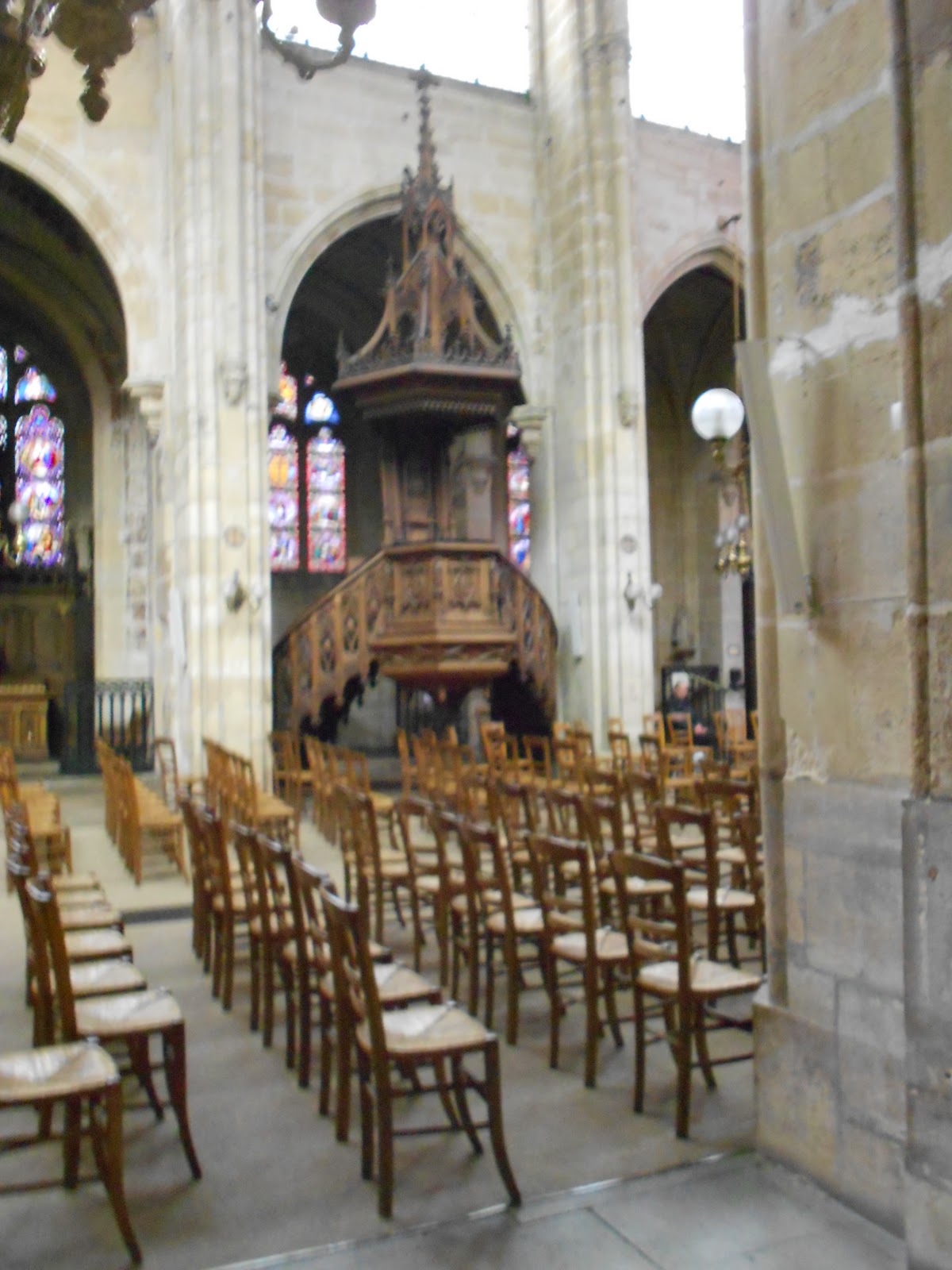


It's bright and airy (in stark contrast to the next church) and the stained glass was nice.  There was a medieval crypt towards the front housing the bones of St Helen; it was super cool but not lit and there were people praying so I didn't want to take flash pictures.  I'm glad I went in, although I knew pretty much nothing about it.

The church I was actually heading for was Notre Dame des Victoires, one of only three places of note in the 2nd arr (including also the Bourse and the national library, which I'll get to in a bit).  I had never been there and didn't know much about this one, either, except that it's pretty well known.

Before I got there I went through the Place des Victoires, a little shopping circle a couple of blocks down from the Louvre.  The statue is Louis XIV, who indeed had probably more than his fair share of victories.  The buildings are mostly 17th century, to go with the 17th century king.


Moving right along...here is the facade of Notre Dame des Victoires.  I was struck by how much it reminded me of the 17th century churches in Italy - in shape and decoration.  I don't particularly like that style, though.


It looked rather dead from the outside, so the inside was a bit of a surprise.  Upon entering my thoughts were something like, "holy...holiness!"  I immediately got the impression that this is the most religiously active church I've seen in outside of probably Sacre Coeur.  

The number of candles!  They must spend a good deal of time worrying about fires.  I go into a LOT of these churches, but I have never seen this many candles lit.  This church seems to be pushing a few saints (or soon-to-be saints) pretty hard.

Here is St Theresa's (of Lisieux...I think) shrine.  Poor thing, a weird reflection is making her eye look rather deformed.  


And here's one of a couple that is titled Bienheureux...which means very happy, so I'm not sure if they're venerable or blessed.  Sorry.  Also this picture sucks.


And just next to these two was one for the last pope.  Every shrine in this church had at least 100 candles I would say.


It was one of the most dark and somber churches I've visited here and I felt distinctly unwelcome taking pictures.  I tried to get some shots of the frescoes around the front alter, which were really nice, but when I got home I saw that they didn't come out at all.

So, I've gone through the western and eastern ends of the 2nd arr, but what is in the middle?  Shopping.  Lots of it.  One of the oldest shopping districts in Europe, actually.

Before I get to that, though, I read that the former location of France's national library was near the shopping area so I went to check it out.  I was expecting a large, imposing, possibly Baroque or neo-Classical building; this is what I was not expecting:


Most of the library appears to be in those metal trailers.  You can see a bit of the building in between them but I couldn't even get into the courtyard.  Oh well.

So, the middle of the 2nd arr is home to the first malls ever.  In the mid-late 18th century some rich people enclosed some of their private property, tiling the floors and putting in glass ceilings, and renting out the space to merchants.  They would set up shops in long rows called passages, often connecting, and people could stroll through and go to a wide variety of shops without going outside.

Most of these are gone but this few in the 2nd arr have survived.  Today they have an interesting mix of shops, one of which - an antique book seller - I had to really restrain myself from going into.  They're pretty narrow and don't get a ton of shoppers today but they're nice for an interesting stroll.


Aside from these passages, there is also a whole section of the middle area that is blocked off to cars, all made up of narrow streets filled with shops, restaurants and cafes.  It's very cool, and a great place to spend a leisurely day shopping.  If you are interested in the everyday street fashion of Parisians, definitely check out the Montorgueil section of the 2nd arr.

Finally, the last things!  In my wanderings, the 2nd arr has offered the most amusing restaurant/cafe names of any other area.  My favorites:


These two happen to be across the street from each other. The first one is called "The White Wolf" and the second is "The Three Little Pigs."


Speed Rabbit Pizza just made me laugh.

Things not to miss in the 2nd: the Montorgueil shopping area and the enclosed passages, and the St Leu St Gilles church, if you're into that sort of thing.  Everything else I discussed was interesting, but not imperative to see.

Food, part II

So last week I discussed the general food culture here, but I also wanted to share the more practical aspect: how one buys food here. 

There are three types of venues at which to get groceries: grocery stores, open air markets, and specialty stores.

Grocery stores are for everyday, packaged and/or processed items.  They aren't even close to as big as American grocery stores and are much more limited.  Usually they don't have much other than food items - though some will have a limited selection of toiletries and cleaning supplies - and you have many fewer options.  For example, in a medium sized grocery store here you would find probably two shelves maybe 5 or 6 feet wide of dry cereal selections, which is like nothing compared to most medium-sized American grocery stores.  So you have a much smaller choice in most things like that, simply because the French aren't big on food like that - but you have a very wide array of things like jams/preserves, yogurt, cheese, pork products, and "biscuits" (which are not American style biscuits but British style - simple cookies, more like "digestives").  Also any French grocery will have a large selection of wine and possibly beer and liquor.  Finally, the produce section is very, very small because most people buy produce at markets.

Here are two grocery trips for me, two weeks apart.  The first was a BIG trip for me!  Usually my week's groceries come to around 25 euros but this one was almost 40.


Going from top left: delicious little snacks that are basically thin crackers dipped in dark chocolate; eggplant cooked in tomato sauce (I often use this on pasta); two jars of lentils (I LOVE lentils and can eat one of these in one sitting); yogurt (I think); pesto sauce; tomato sauce with pancetta; apple juice (I'm obsessed with this store's brand bio apple juice, it's the most delicious ever! But unfortunately they run out of it a lot so I had to get an inferior one); banana, pineapple, and coconut smoothie; vegetable tortellini; pasta; 4 cheese ravioli; dark chocolate mousse; shredded cheese; chicken soup mix.

Second, from today!


Two types of pasta; two jars of lentils; yogurt; strawberries in syrup (it goes very well with the almond cake below); caramel rice pudding (OMG wasn't meaning to get this but how could I resist?); vegetable tortellini; those same dark chocolate dipped crackers; sandwich bread (first time I've ever bought packaged bread here but last week I got peanut butter so...); plain rice cakes.

So as you can see, I get some basic staples, snacks, and beverages from these stores, mostly.

Second type of place, open air markets.  Most of the markets in Paris are open three days a week (they alternate usually with another one in the area), and there are a lot of them.  I live within less than ten minutes walking from two, and about twenty minutes walking from four. 

These markets have all kinds of things.  I know I've talked about them before, because I love them, but I took some pictures today (and felt extremely stupid doing so!).  Although my current market is bigger than the one near where I lived over the summer I don't like the vendors as much.

All markets start with little metal stalls that are built each market day and taken down in the late afternoon.  Then they spray down the squares, getting rid of any produce left on the ground.

My pictures represent only a small part of the market, as it's difficult to get everything in a few shots.  I would estimate that there are 2 florists, 2 carpet/cloth people, 2 seafood people, 2-3 butchers, 4-6 fruit/fruit and vegetable sellers, 2 only-vegetable sellers, 2 bakers, 2 laitiers (eggs, milk, yogurt, creme fraiche), 2 cheese sellers, 1 Lebanese/Middle Eastern seller, 1 dried fruit, nuts, olive person, 1 herb/spice person, 1 foie gras/pate person, 3-5 jewelry people, 2-3 clothing people, 1 scarf-only person per larger weekend market. On weekdays not as many food vendors come and there are generally more clothing/jewelry people.

Here is a carpet/tablecloth/general cloth seller, on the left, and flower seller on the right.


Two vendors that sell fruit and vegetables.


The dried fruit, olives, and nuts guy.


One of the seafood sellers - this one had a HUGE line today.


This one in the foreground is an odd mix - they sell dried herbs, olives and olive products, various traditional southern French spreads, and specialty savory breads ("pain" means bread).  Across from them is a butcher.


One of the florists, and some fruit in the background.


This fruit and vegetable seller's stall is the whole length of this shot - from the leeks in the foreground to the corner of that other produce seller in the back.  Generally the produce people get stalls like this and everyone else gets like half of this space.


I tried to get a shot from one end of the square to show how big the market is but this was a fail.  It covers one big square block.


Inspired to make myself a Thanksgiving feast, I got some extra desserts at the market today.  :)  I already had some salad stuff and couldn't find any green beans without a long line so no vegetables today.  Here's what I got:


Bananas, clementines, apples, hummus and pita, dried apricots, an almond bread/cake thing, and a chocolate fondant.  Normally at this time of year I've been getting grapefruit as well but it didn't look great this week.  If I were at my other market this weekend I would have also gotten some stuffed grape leaves, tabbouleh, and moussaka from my favorite Lebanese food guy.

This was a pretty small market trip for me, because as I said I didn't get any vegetables.  I usually get one head of lettuce, one or two carrots, one or two cucumbers, some green beans, and anything else that catches my eye. 

Third place to buy food: specialty stores.  I wanted to get some pictures of some of these storefronts but haven't been able to/haven't had my camera on me when I passed.

Types of specialty stores here - at least one in every neighborhood: boulangeries (bakers - all types of bread, sandwiches, quiches, tartines, breakfast pastries)/patisseries (pastries) - often the same but not always; poissoneries (seafood); fromageries (cheese); laitiers (eggs/milk/yogurt/milk products but not always cheese); boucheries (butchers - often, but not always having poultry in addition to other stuff); volailles (just poultry); vignerons (wine).  Foie gras/pate stores are not quite as frequent but I see them all over as well. 

I mostly frequent the boulangeries, fromageries, and vignerons because I basically never buy meat and get my eggs and yogurt from the grocery store.  But many French people, especially smaller households, will go to each of these stores pretty often.  The couple I lived with a few years ago would go to every single one of those places probably about once a week, a grocery store about once a week, and the markets twice a week.  For two (three including me) people.  This is pretty much unthinkable in most of the US because it seems inconvenient - but really, you get such better quality foods and often at better prices than a grocery store.

Also you get to know the vendors/proprietors and that's always nice.  They can get a feel for the things you buy frequently and will often give you free samples or lower prices a bit.  I've talked about my friend the Lebanese food guy before, but I'm also recognized by two produce sellers at my old market, one of the bakers at my new market, and the wine store guy around the corner from me.  For example, the baker guy (from whom I bought the almond and chocolate cakes above) knows that I want to try the pain d'epices, a traditional type of French bread, but I've never really wanted to buy the whole thing - so today he told me that next week he'll be giving out samples of a special orange pain d'epices and he'll give me half of one for free if I get there before noon.

I actually really enjoy food shopping here because it's a much more interesting and personal experience than it often is at home.  And, I'm not sure whether I think this just because I like the experience better or because it's true, feel like the products are better than what I would generally get in the United States, or even if I got everything just from grocery stores here.

Thursday, November 24, 2011

Happy Thanksgiving!

This was my Thanksgiving dinner:


Salmon and tuna sushi, an apple, and a smoothie.  Yum!  But not quite your traditional Thanksgiving.

I found an American food store here and I know that they have mixes for stuffing and gravy and some other things that might have been nice, but I was so busy during the days this week and generally was out of work too late to get there (it closes at 7pm).

I was going to Skype with my family but evidently they all forgot that was happening.  So instead, here am I doing a blog!  It's definitely the most pathetic Thanksgiving I've had.  Maybe this weekend I will get the food and make myself a post-Thanksgiving feast.

Anyway, from what I've seen most French people are aware of Thanksgiving's existence, but are unsure what it's about.  One asked me how it's different from Christmas, and J keeps mixing them up (when I told him Thanksgiving was today he said, oh, you don't have Christmas in December?).  I found that pretty amusing - it takes a bit of explaining to get them straight on both holidays.  Especially when I get into what it's supposed to commemorate and the fact that that incident is almost completely made up...

Also most were surprised that it's supposed to be on a Thursday.  I guess that's too specific for people who make the "holiday" of All Saints' Day a week and a half long!  J was absolutely in raptures today when I described to him all the food we make/eat on Thanksgiving, it was cute.  He would definitely love a day that's all about eating to excess. 

I hope you all are having a good Thanksgiving!  I'm going to do a bunch of posts this weekend, so stay tuned.

Sunday, November 20, 2011

1st arr

The 1st arr is one of the most interesting, both in terms of history and present day.  It takes up a small area of the right bank and about half of the Ile de la Cite, one of the small islands in the Seine. 

It is the least populated, most visited, and most number of Parisian commuters per day.  This is because is has a huge amount of tourist attractions, tourist shops, restaurants, and businesses - and not a lot of residences.  Wikipedia tells me the 1st arr only has a total of one middle school and one high school.  Things you can find in the 1st arr: the Louvre museum; the Palais Royal (royal palace); the Tuileries gardens, which have the Orangerie and Jeu de Paume art museums; the churches of Ste Chapelle and St Eustache (my commentary on that one here); the Chatelet/Les Halles shopping district and commuter area; Place Vendome shopping area, which has many of the most exclusive jewelers and fashion designers; the "old" Bourse, the previous economic center of France, which is still very active in the government's economy; the headquarters of the Paris police; the Conciergerie, a huge former prison.

Essentially, you can't walk a couple of blocks in the 1st arr without finding another landmark.

I can't take credit for any of these pictures except the last one.

The old Bourse.  I guess was kind of the equivalent of the NY Stock Exchange.


The Place Vendome - the column is modeled on Trajan's column but describes Napoleon's exploits.  This one is a copy of the original, which was destroyed in the Commune uprising in 1871.


Inside Ste Chapelle.  The walls of this little church are almost entirely made of breathtaking 17th century stained glass.


The Tuileries gardens, just beyond the Louvre palace.  That ferris wheel is there seasonally but I'm not exactly sure when, as I don't think it was there this past summer.


St Eustache, next to Les Halles.


It's pretty easy to see why the 1st is the most visited arr in Paris, especially frequented by tourists and those who serve tourists.

As I mentioned in the last post, the 1st arr is considered the oldest area of Paris.  It's really not, as other areas were inhabited by the Gauls and Romans first, but the city of Paris as "Paris" was indeed more or less founded on the Ile de la Cite.  The government was set up just across the river, and from the fall of the Roman Empire until approximately the mid 17th century this tiny area of Paris ruled all of France.  The monarchs lived in the Louvre Palace (and its earlier incarnations) from early medieval times until the reign of Louis XIII (early 1600s), when they moved across the street to the Palais Royal.  They lived there for about 50 years until Louis XIV (mid-late 1600s) moved everyone to Versailles.  Almost the entirety of the French court - meaning all the nobles who made up the king's counsel and the minsters who ran the judicial system, the economy, the military, etc - had to live within an easy distance of the king, so most lived at least part of the time there, too.  For this reason the Bourse, which was the center of the economy until the 20th century and the central office of the police and military, were set up in the area, and the most important churches were there as well.

So this tiny area, not even one mile square, was the headquarters of France for almost one thousand years - and during much of that time France was the preeminent country in Western Europe.  It governed and created the culture and fashion for half a continent.

However, when Louis XIV moved the court outside Paris the two royal palaces were more or less abandoned and the nobles moved their homes away from the center of the city.  Members of the emerging middle class - so, bankers, merchants, etc - moved into the area and over the next century it had a strange dichotomy between these wealthy, business-minded bourgeois, and starving, homeless artists and vagabonds who squatted in the abandoned palaces and their grounds.

The Louvre itself was in such disrepair and provided shelter to so many homeless that the government considered demolishing it before the Revolution in the late 1700s.  This didn't happen in time, though, and when the revolutionaries took over the government they again made their headquarters in the Louvre and Palais Royal.  They destroyed the third royal palace, the Tuileries, during the Revolution, and all that remains of that today is the garden.

When Napoleon came to power he, too, decided to live for a time in the Louvre.  He was the one who started the art gallery in the palace that is now the most famous museum in the world.  He and his descendant Napoleon III built up their collections, which were seized but kept in the palace after the fall of the 2nd Empire in the mid 1800s.  From that point on the Louvre has only been a museum.

Two lesser-known museums are close by, as well: the Orangerie and the Jeu de Paume.  The Orangerie takes up an area that was dedicated to growing orange trees during the monarchy's tenure in the Tuilerie palace.  The museum was built specifically to house the large collection of Monets that the artist gave to the French government towards the end of his life.  He also gave instruction on how the building should be set up to display his paintings.  Today it has possibly the best collection of Impressionist paintings outside of the Musee d'Orsay, just across the river.  The Jeu de Paume is also a small museum, and it generally has rotating exhibits of lesser known, more modern artists.

Today, as you might imagine, it has a rather busy, impersonal atmosphere.  The architecture is gorgeous and the whole arr is nice to look at, but everything is very sterile, carefully set up to be a tourist trap.  I always like the idea of visiting the 1st arr but when I get there I'm generally frustrated by the hordes of slow-moving, lost tourists and the overpriced tourist shops that always seem to ooze out onto the sidewalks.  The restaurants aren't great (although it does contain Hemingway's favorite spot, which is kind of a cool, but way overpriced, bar) but not terrible, and generally cost too much for their quality.  If you've never been to Paris it's definitely worth a visit but unless you're in one of the many museums there is no reason to stay very long.

Best spots in the 1st arr: the Louvre (duh); the Orangerie; Ste Chapelle (and generally the Ile de la Cite); Angelina's, a cafe with the best hot chocolate ever; the little walking area right next to Les Halles; Bar Hemingway.

Background of arrondissements

Before getting into each of the arrondissements (arrs) I'll tell you a little bit about what they are.  We don't really have the equivalent of arrs in the US; virtually every medium-small town to big city in France is split into districts - the arrs - for administrative purposes.  Their being official is rather modern, but more often than not the arrs are based on long-standing historical borders.

There are twenty arrs in Paris proper and one interesting thing about them is that they are numbered roughly according to when they were incorporated into the city.  So the 1st arr is considered the very oldest area of Paris (although really the 4th and 5th probably are, as they date back to Roman times, but the 1st was the first area of the "French" city), going on until the higher teens, which were considered suburbs only a century ago.

However, their numbering also follows a "snail shell" pattern starting from the first: they make a tight circle around the center of the river, then a wider circle.


In this map you can see how they start from the 1st, which is just on the north side of the river [we consider this the "right bank," and the south side is the "left bank"], and form the snail pattern.  It also shows the more common names of most of the arrs.

When you meet another person who lives or has lived in Paris, the first thing you ask is what arr they were/are in.  Each arr has a distinct history and current atmosphere, different things they are known for.  Usually when you're planning a meet-up with people you'll give them a general idea of what type of place you're going just by saying which arr it is in.

I hope the posts about them are interesting, and please let me know if you'd like me to continue them after I post the first one!

Saturday, November 19, 2011

A propos!*

My dad just sent me this article: http://shine.yahoo.com/shine-food/how-to-order-at-a-french-restaurant-without-sounding-dumb-or-pretentious-2597522.html

Just a couple of silly quibbles: 1) No French person would call a brasserie a bra-ser-ee because they are lazy (like how lots of our words get mangled from laziness).  It's a brah-sree.  I remember when I first started taking French I would read aloud from Le Petit Prince or Les Miserables with my mom, to practice, and she always corrected this in the words "cependent" and "maintenent" and I just couldn't get the hang of it until I heard real French all the time.  Same thing with macaron, it's not mah-cah-rohn, it's mah-croh, with a nasal n.

2) I'm pretty sure not many American people would know what you meant if you said crehp for crepe.  I've only ever heard people say creyp there I think?

This reminded me of an incident just after I came back from living in Paris last time.  I went out to dinner with a friend and we got coffees or something after.  The thing I ordered was hot chocolate with orange flavoring and the menu called it something like chocolat a l'orange.  Having just returned within the week I automatically said it the French way and the waitress didn't understand at all.  I repeated it, trying but failing to make it more English-sounding, but she still didn't understand.  Very embarrassed, I had to just say, "the one with orange."  My friend laughed at me for being pretentious but I really couldn't get my tongue around the English pronunciation! 

Second a propos thing: on a whim today I decided to get a pastry with my daily baguette at my corner boulangerie.  It was still early enough in the evening that there were lots of delicious-looking ones left.  I really liked the look of a whitish one next to a small sign saying "framboisier chocolat," meaning it was raspberry and chocolate.  Yum.  So I asked for that, but the girl grabbed another one, in the picture below it's on the left.  I was confused and pointed to the white one near the sign and said, "No, that one."  The boulangerie was quite busy so after I saw her pick that one up I moved along to pay.  I told the cashier what I got, paid, and went home.  Upon opening my box I was surprised to see both pastries. 


The one on the left seems to be the real "framboisier chocolat" and I have no clue what the one on the right actually is.  It does have raspberry and chocolate but the white frosting-like stuff was almond-tasting and there was some white cream in the middle.  On a good day I can only eat half of a pastry like this at a time so I'm going to have to make a concerted effort to eat both of these in the appropriate time.  A hardship indeed.

* Sometimes I feel like living in France makes my English a lot worse.  This is two words in French but one in English, right?  How embarrassing.

Food, part I

Food is an integral part of French culture, so I guess it's not surprising that I get a lot of questions about it.  Not questions so much as, "Omg the food there must be amazing!"  Or sometimes, "How do French people stay so slim with the kind of food they eat?"

To respond: yes, food here is very good, and overall I would say a higher quality than food in the US; French people don't actually eat most of our stereotypes of "French food" that often, and have generally very different eating habits.

For many years in English-speaking countries, French cuisine was considered the very highest, fanciest level of food.  I just did a quick Google search of French food main courses and came up with: boeuf bourguignon; French toast stuffed with brie; braised rabbit; chicken in cream sauce; beef tenderloin in wine sauce; cheese souffle...

This is very much not what French people eat on a day-to-day basis, but it is more similar to what you would find in a French restaurant in the US.  All those heavy cream sauces and large amounts of red meat, etc, are unusual fare.  What is true: there are LOTS of pastries, all the time.  Many people have a croissant (very buttery of course) or pain au chocolat (basically a croissant stuffed with chocolate) every day, and many people will get a dessert pastry or little cake once or twice a week.  And many, if not most, French adults have at least one unit of alcohol - normally wine, but often beer - per day.  Bread is a huge staple of a daily diet as well; most small families can easily go through a baguette every day.

The biggest difference I see between French and American food cultures is how we eat (approach to food) and the starting point of the food we eat.

Firstly, the French absolutely love their fruits and vegetables.  I've never been in a French home - even of poor college students - that did not have at the very least one or two large bowls full of fruit all the time and vegetables filling the fridge.  The couple I lived with the first time I studied here had almost their whole small patio dedicated to housing their supply of produce, and the family I'm working for now always has a huge amount of fruits and nuts - I'm talking feet of counter space - and two fridge drawers of vegetables.  They replenish a few times a week.

Generally vegetables, while not the highlight of a dinner, take up about half of one's meal.  It is exceptional to have more than a small portion of red meat at dinner and it is much more often chicken or some such. 


In both families, dessert was/is almost always a piece of fruit or a yogurt.  Sometimes with the family I work for there is one ice cream cone per two children after dinner.  More often than that it's a small piece of chocolate, usually dark. 


Overall portions are much smaller here than in the US, even (or especially) in restaurants. 


Finally, and probably most importantly, food is very much respected here.  A lot of time is set aside for a meal - to enjoy it, to chat, to people-watch or read if you're alone.  School children and working people usually get an hour and a half or two hours for lunch and their day ends a little later.  You will rarely find a French person eating while walking or in the Metro. 


Every loaf of bread I have ever bought living here has come direct from a baker and was baked the day I bought it.  The ingredients in these are super simple, with no additives or preservatives - just the way you would bake it if you made it at home.  Same thing for the pastries and desserts you can find in any bakery.  It isn't a matter of principle or pride, like it would be in some shops in the US, it's just the way things are done here.  Why buy a processed loaf of bread when there are delicious bakeries on every other corner?

Cheese/dairy shops, butcher shops, all those places have similarly fresh, straightforward products.  You won't find a load of chemicals in any of them.

The packaged and processed foods here are also generally less so than in the US, I think because they're competing with the products I just described.  There are regulations about how much high fructose corn syrup food companies may use (though I have no idea what those are) such that, for example, Coca Cola uses real sugar instead in its products here.  This might also be a function of the fact that a lot of French overseas departements (protectorates, I guess) rely heavily on sugar production; I'm not sure.

So we end up having higher quality ingredients to start with here, and processed products do not have the same advantage here as they do in the US: if you're buying for many people it's often considerably cheaper to buy fresh foods.

---

Hooray, French food!  Delicious, fresh, and fairly cheap, how can you go wrong?

Well, I've just spent a good amount of space praising the food culture here so I probably shouldn't complain too much.  But!  There are some odd things I just can't find here, and some are a little baffling.

First and foremost: peanut butter!  It just seems to...not exist here.  This came up a couple of days ago when J asked me what my favorite flavor of fudge is.  I said peanut butter and he didn't understand.  I described it and he said he'd never heard of it, though he did say defensively "we do have peanuts, though!"  This is unfortunate because 1) I think the kids would love peanut butter cookies and 2) sometimes you just want a peanut butter sandwich, you know?

Secondly, because they go together in my mind, marshmallows.  I've never seen any here.

Canned soup.  You won't find any canned chicken noodle soup, minestrone, etc here.  You might find it in a mix.  You will find boxed vegetable veloutes or cream soups.  This is probably healthier I guess but I'm dying for some of the vegetable, black bean, or pasta soups I love in the US.  Sure, I could make them, but that takes some effort!

Anything spicy.  I've discovered that the French hate spicy food.  Not hate, exactly, but you will certainly not find anything I would call "spicy" without looking pretty hard.  They will say that some (to my mind) mild Chinese, Indian, or Vietnamese food is "spicy" when it's clearly not.  They don't really even do the spicier Italian sauces or sausages.  My mother suggested that this is because French cuisine is all about herbs and they just don't really have a taste for spice or don't like it overpowering the herbs.  Either way, I want some good, spicy Mexican food.

Lastly, this isn't exactly a lack, but Parisians are weirdly obsessed with cookies.  Big, soft cookies generally, but cookies in general.  I would compare it to the cupcake obsession in NYC: there are "designer" cookies and some little cookie boutique-type things.  But they're also kind of regarded as a very special, high class treat that aren't really for making at home.  I find this bizarre because cookies are so easy to make - and they're not eating especially complicated ones, usually chocolate chip or sugar cookies or something.

Their fondness for fudge and brownies is sort of similar, but to a lesser degree.  All of these things are considered very American.  When I talked to J about making them himself he seemed surprised at the idea.

Wow, this has been much longer than I intended.  To be fair, I'm hungry!

Wednesday, November 16, 2011

A dull life

I just wanted to let everyone know I'm here and I have a bunch of posts planned - but for the moment I have nothing exciting going on at all and I'm having a bit of a writer's block.

I was really and truly planning to do a big post on the food culture tonight but I've been hit with an unexpected wave of tiredness.  I've been sort of fighting off a sickness since the weekend and I want to make it through the rest of this week without getting sick so I'm going to try to go to bed super early.  Sorry, Mother.  I think baby O and I keep trading colds back and forth.  He'll be somewhat sick for a few days and then a couple of days later he'll be better and I'll start to get a cold.  Then I'll get better and he gets it again.  That's been happening for the last month or so. 

I will do an actual post tomorrow, but in the meantime here are a few posts that have been floating around (just to give you a preview!):

- Notre Dame has a Gregorian mass every Sunday morning.  My love of chant is well-known and I'm super excited to see this happen in such an amazing venue.  I've planned to go the last two weekends but things have come up.  I'm hoping I can this weekend, but if I have to work early this Saturday I probably won't go.

- Food.  There are a lot of differences in the food culture between here and the US - how people eat, what is available, and how/where you buy it.  I get a lot of questions about French cuisine so I think this might be interesting.

 - Some museums I'm planning to visit, hoping I'll find some interesting stuff.

- Not sure if this would interest people, but I was thinking of doing a once-in-a-while post on each of the arrondissements of Paris, possibly starting tonight.  We'll see if people like it!

Friday, November 11, 2011

I might have to go to a Justin Bieber concert today

That is all.

Edit:  It's past 7:30pm now so I think I'm safe.  I was completely horrified.  In the mother's words I "look like I could be a friend of theirs [the 14 year old girls going]."  :-O

Monday, November 7, 2011

Through Paris at night

Sometimes I walk home from work, if I have time and am not too tired.  Since our nights with nice weather are numbered, yesterday I decided to stroll home, documenting my progress along the way.  The walk takes about 25 minutes going slowly and it's very pleasant.

I leave their apartment.  I'll be on that cross street up ahead until I'm nearly home.


I think local elections are coming up, and I see political signs like this pretty frequently.   The one on the right says "save our jobs, leave the euro."


There has been construction going on around the corner forever.  This is a nice little area though - I particularly like the cafe on the left with the red awning.  It's a nice place to sit and have a hot chocolate.


 The construction


I leave their immediate neighborhood and head in the direction of O's daycare (about 5 minutes away) and M's school (about 10 minutes away).  Even crappy apartment buildings in Paris have cool architectural details - so many have lovely big windows like this with pretty moldings.


There are little signs like this all around the city, set up in places of historical interest.  This one, right around the corner from the daycare, marks a building that used to be a Carmelite convent.  The church there is still active and I see nuns around so I'm not sure it's completely separated from its history.  The sign notes that the convent was disbanded in 1792, reinstituted in 1797, a school was founded there in 1845, and from 1849 to 1867 monks lived there.


Just past M's school is the Luxembourg garden.  Since I was here around 7:45pm it's closed and because of the dark I couldn't get many good pictures.  Suffice to say, it's very large and very pretty.  It will take me about 10 minutes walking to pass it.


I pass some pretty streets across from the gardens.


The buildings that made up the Luxembourg palace are now used for a variety of purposes.  This one is now the Luxembourg museum, which has an exhibit at the moment called "Cezanne and Paris."  This whole side of the garden is guarded by armed police because... (it's coming in a couple of pictures)


Another pretty street, this one cobblestone and very narrow.


This sign discusses the history of the smaller palace on the grounds...


 ...which is now...


the French senate.  That's why there are armed guards throughout this area.  They were giving me the side-eye as I was taking pictures of the building so I hurried away.  You can't see it very well but above the door it says "Senat."  In the corner you can see the French and European Union flags.


Almost past the gardens now, I walk through the entrance way to the famous Odeon theater.  Lots of the most famous French plays premiered here, and it set a precedent for this area to become a mini theater district.  There are also like five different movie theaters within a few blocks.  It's also kind of the border between the Luxembourg neighborhood and the Latin Quarter (where the students of the Sorbonne and other schools live and hang out - and have since the 1200's). 


 On the next corner I pass a little restaurant that claims to have been founded in 1791.  Dubious.


Now I'm really in the student neighborhood, and it looks a lot like what I'm used to in NYC.  You can see an open-nearly-all-night mini grocery with some guys, probably university students, hanging around outside.


One of the first Sorbonne buildings I come across.  I don't really know what this building is but it has a square all to itself.


The Latin Quarter is known for its very rich history of famous writers and philosophers who have lived here.  I pass a number of similar plaques along the way but here is one saying Gabriel Garcia Marquez lived in this building while writing "No One Writes to the Colonel." 


Getting very close to home now - around the next corner I can see the top of the Pantheon.  I pass Lycee Louis le Grand, the second most prestigious prep school in France, after the one I've featured here before, Henri IV.  They're about a three minute walk from each other.


You know you're in the heart of the Latin Quarter when you start to see tons of random, bizarre political signs.  This particular building is covered with them - unsurprising I guess since it's a block away from three different major political science buildings and the law school. 

This one argues that no one should use the term "mademoiselle" anymore.  I assume because it's somewhat less respectful than "madame" and connotes youth and inexperience.  I've had people instinctively call me "mademoiselle" (because I look young I guess) and then apologize profusely for it.  Anyway, men only have the option of being called "monsieur" so this feminist group feels women should only be "madame."


I walk a bit more up the hill and come into the familiar Place Ste Genevieve: on the left is the the library, far off in the middle is the church St Etienne-du-Mont, and to the right of that is the tower of Lycee Henri IV.


This picture shows you nothing, I'm sorry.  This is one of those times I wish either I carried my camera around with me all the time (these were all taken with my phone, which explains the poor quality) or that I had Photoshop on my computer.  This little sign is next to a door of a building right next to the library, and it says that until 1950 that door was the entrance to the Collège Sainte Barbare, founded in the mid 1400's, and whose entrance is now next to my street.  To my knowledge "collège" means junior high/middle school in French, but somehow I doubt people were founding middle schools in the mid 1400's.  It definitely means an education facility of some sort but I don't know exactly what.  For now I'm going to think of it as the oldest middle school ever.


And I turn onto "my" street - not really mine because it's actually the street that leads to the back entrance of my building, but it's how I get in most of the time.


The actual back entrance is on a little dead end called the "Impasse des Boeufs."  Boeufs means cattle or beef, so this means "dead end of cattle or beef."  Many people are highly amused by this little street - coming back from the airport last time my cab driver declared it "magical."  Google translate will tell you that the whole name means "dead oxen."  I wonder when was the last time my little street saw any cattle. 


And then I'm home!

Saturday, November 5, 2011

What a day

I had a super long day on Wednesday - I left my apartment for work before 8am and got back a little after 9pm.  The end of the day wasn't that interesting but the beginning was kind of a disaster.

I was supposed to take the two oldest children and 3 year old M to Disneyland, which is just outside Paris.  When I got to their house it turned out I would only take the oldest, 14 year old D, and M.  That was okay, as I knew D would be more helpful in looking after M if her brothers weren't there.  We planned what rides to go on and where to stop, and M was super excited as she doesn't go very often.

They have special passes for the older kids that makes it cheaper for them to go several times a year but M and I would have to get tickets of our own at the normal price...or so I thought.  The mother gave me 100 euros for the tickets and lunch; I thought that was strangely little for the two tickets and food but I figured the tickets for little kids must be very cheap.  Upon arriving D told me that children two and under actually get in for free, so we were supposed to pretend M was two.

She doesn't look two.  She's three and a half, and decently tall for her age; she just does not look like she could be two.  But it ended up that my ticket was 51 euros and if we were to get one for M it would be 48 or 49 (D's pass gave us a discount of some percentage, I forget).  Meaning if we did that all the money the mother gave me would be gone and we'd have to use my 10 or so euros for lunch for all of us - not possible at Disneyland.

So I went along with it, not getting a ticket for M, but inevitably they stopped us going in, wanting to see an ID card for M.  When they asked her how old she was she held up two fingers but then said three, so we were pretty much screwed then.  We had a dilemma at that point: buy M a ticket and see what we could find to eat or leave before lunch?  Get a refund for my ticket and go home?  We'd traveled about 45 minutes to get to Disney and we'd been gone over an hour at that point and M was getting impatient.  Not to mention since we were there she was even more excited, seeing we were just about to get in.

After some fretting and discussion with the mother we decided we wouldn't be able to go into the park.  M was absolutely inconsolable and cried hysterically for almost a half hour while we tried to calm her.  Eventually D remembered that there is a movie theater attached to the Disney complex and we decided to take her there instead, and buy her some souvenirs.

That was actually a pretty good turning point, and she was really happy to see the movie.  I ended up liking it a lot too: it was a French animated kids' movie, Un Monstre a Paris.  Here is the trailer in French: http://www.youtube.com/watch?v=et1T4c-BNUk and English http://www.youtube.com/watch?v=AfMcbsE-kf8.  Vanessa Paradis, a very famous French singer and actress, voiced the lead role and the music was so good!  I'm actually sad I can't find it to download anywhere.  I would definitely recommend it if you want a good kids' movie.

We got her some lunch, bought her a stuffed animal, and left.  They're going to go back in a couple of weeks I think but I'm not sure if I'm going.

This week has been really long in general but I am much happier now that the kids are back in school.  Thank you to everyone who sent me messages while I was upset earlier in the week!  I really like hearing from people and you brightened up my day!