Tuesday, June 12, 2012

Blast from the past - Milan part 1

I recently realized that when I did this a few years ago I was scandalously remiss in posting pictures from my trip to Italy, and also some of my French adventures.  Unfortunately I have gotten a new computer since then and nearly all of my pictures from those trips are on my old computer, which is in NY.  All I have on hand are the pictures I posted on Facebook from Milan.  However when I go back to NY in July I will transfer my older albums to this computer so I can finally show them off.

Just note: the camera I used for these pictures was not very good, so the quality isn't great.  Also I couldn't figure out how to turn off the stupid date stamp.  Keep in mind that one of the primary goals on this trip was to check out lots of church art and architecture so there will be an overwhelming amount of that here.

Okay!  Onward.  Milan was my first stop in a tour of five Italian towns and cities that I visited for my spring break in 2008.  I believe I ended hitting all my main stops here in the three days I had.

Milan is pretty well known I suppose, but I'll give a bit of background.  It's a very old city, with evidence of pre-Roman settlements.  It's had three main important historical periods: it was a place of religion and learning in the 4th century AD, under the influence of the renowned Church Father St Ambrose; it was a main center of the Italian Renaissance under the patronage of the Sforza family in the 15th and 16th centuries, and finally it was an area of political dispute and turmoil in the 19th century.   I'll touch on things from all these periods but it would be a bit ridiculous to try to get through everything.

An important thing to note is that Italy was not unified as a country until the late 1800's.  It was split into independent city states that were ruled by very wealthy dukes who rarely started out as royalty - they generally bought their way into power and consolidated it by a combination of power, intimidation, and patronage.  This political system is what paved the way for the Italian Renaissance, as the families tried to outdo each other culturally as well as politically, and tried to keep up with the royal houses of Europe.  In doing this they poured tons of money into supporting famous artists to make works for them.

One of my first stops was the Ambrosiana Library, one of the oldest and most renowned archives in the world.  My nerd excitement meter was through the roof here!  Not only does this place have sketches and paintings from tons of great Italian artists like da Vinci (it also has some of his notebooks and manuscripts), Raphael, Botticelli, and Caravaggio, it also has a ton of ancient texts, from Aristotle to some first copies of the gospels.  There is just such a wide range of things here I can't begin to list them all.  Many of the manuscripts and texts are not open to the public, but the windows into the library galleries are glass.  I spent a good few minutes just staring through these windows, wondering what rare and amazing books I was looking at.


Unfortunately pictures weren't allowed inside the museum part when I was there.

This is a bank I came across just walking around.  It looks like a Renaissance bank but the coat of arms isn't Medici so I'm not sure who this belonged to.  Banks, as well as political power, were generally tightly controlled by wealthy families who would display their coat of arms prominently on all the buildings they commissioned.


I had no clue what this building was but it's pretty typical of the Renaissance style mini-palaces around Italy.


The ruling family of Milan at the height of the Renaissance were the Sforzas.  Although the Medici and Borgias are probably the most well known of the Italian mafia-like ruling families, the Sforzas were similar in their power and influence; they patronized da Vinci and Michelangelo amongst others.  The notorious Lucrezia Borgia married a Sforza.

Their castle still exists in Milan and is now a pretty incredible Renaissance museum.  It was started in the mid 15th century and ended up being one of the biggest citadels in Europe.


Here are the grounds of the castle:


 Inside the museum is a mixture of artifacts gathered from elsewhere and things that are part of the castle itself.

Here is an arch taken from an old Medici bank:


A bunch of cool swords:


Michelangelo's unfinished Pieta Rondanini - the difference in styles between this and his earlier idealized neo-Classical works is striking.


 Here is a ceiling in the castle that was painted by da Vinci.  Although I wasn't able to get a great shot of it (the colors are pretty off and I have nothing of the trunks of the trees, more towards the side of the ceilings) this picture is not out of focus.  He had done a number of trees with their leaves meeting at the high center of the ceiling, with the Sforza coat of arms in the middle.


Moving on to what is probably the most well known landmark in Milan: the Duomo.  This is the fourth largest cathedral in the world, and largest in Italy (although I believe St Peter's in Vatican City is bigger).  It took an unusually long time to build - 600 years - and was started in the 1380's, in a flamboyant Gothic style.  It's certainly one of the most ornate churches I've seen, and the stone used is pretty distinctive.


The square in front has tons and tons of pigeons!


Inside the church is absolutely huge, and quite dark.  None of my pictures here came out very well, but it gives a decent impression of the gloomy, rather oppressive atmosphere.  It's much more cheerful from the outside.


The pattern on the floor - the colors, again, are off, but you can get the idea.


A side altar:


This cathedral felt extremely touristy and impersonal to me.  You can read my original entry on Milan, linked above, but I still remember the rather flat feeling it gives off - as opposed to somewhere like Notre Dame, which is also big, imposing, darkish, and very touristy.  It is really lovely, but there is a sense of intimidation rather than general awe or splendor.

There's also a pretty gruesome sculpture of St Bartholomew, who I guess was skinned alive, because it shows him walking, having been flayed, carrying his own skin over his shoulder.  My picture didn't come out very well at all.

I'll end with a few shots of San Lorenzo Basilica, which I did not get to enter.  It has a big and lovely park outside.  This is a particularly old church, having probably been founded around the time of St Ambrose in the 4th century.  It has changed over the centuries, but is still overwhelmingly Byzantine/Romanesque.  You can see it's not Gothic at all, with simpler, cleaner lines based on domes and rounded arches.  I believe it was renovated in the 1500's, but I think it has kept its original outlines.


More to come!

The Ladies of the Luxembourg Garden

I can't remember if I've mentioned this before, but the central path of the Luxembourg gardens, just a 5 minute walk or so from my apartment, is lined with statues of various women who were significant in French history.  The majority of them are queens or duchesses who wielded power in unusual ways.  They range from early medieval times to the 17th century.

I've always been fond of these statues, but I'm not sure why they're there.  All I really know about the statues is that they were commission in the mid 19th century by Louis Philippe, the king during the brief post-Napoleon restoration of the monarchy.  I suspect they are some kind of tribute or reference to Marie de Medici (who is one of the statue women), as she was the queen who commissioned and helped to design the Luxembourg palace and gardens.  She was a forceful and powerful queen and perhaps Louis Philippe wanted the statues to acknowledge her kindred women throughout French history. 

So I'm going to do some little posts on these women (some of the most interesting ones, maybe not so little!) because they include some of my very favorite historical figures.  It was unusual for women to even be noted in the historical record at all during the lives of some of them, so it's an achievement just to be remembered. 

I didn't recognize some of them so this will also be me doing a bit of my own research on these ladies.  Of course, since these statues were made centuries after most of their deaths they aren't actual representations of how they looked - just to note that from the start.

I want to do it chronologically, but I'll start with one out of order, because I've already discussed her: here is Saint Genevieve, the patroness of Paris, lived 423-512.


Monday, June 11, 2012

Concert in Bains-les-Bains

Firstly: the town we performed in is a tiny place even more in the countryside than Damelevieres, the exceptionally green place I showed pictures of here.  It's called Bains-les-Bains, which is a ridiculous name meaning "Baths the Baths."  Think a place like Bath, England, where historically people would go to "take water" from the springs there for their supposed healing powers.  It was an hour and a half bus ride from Damelevieres, which is a 15 minute train ride from Nancy, the biggest town in the area.

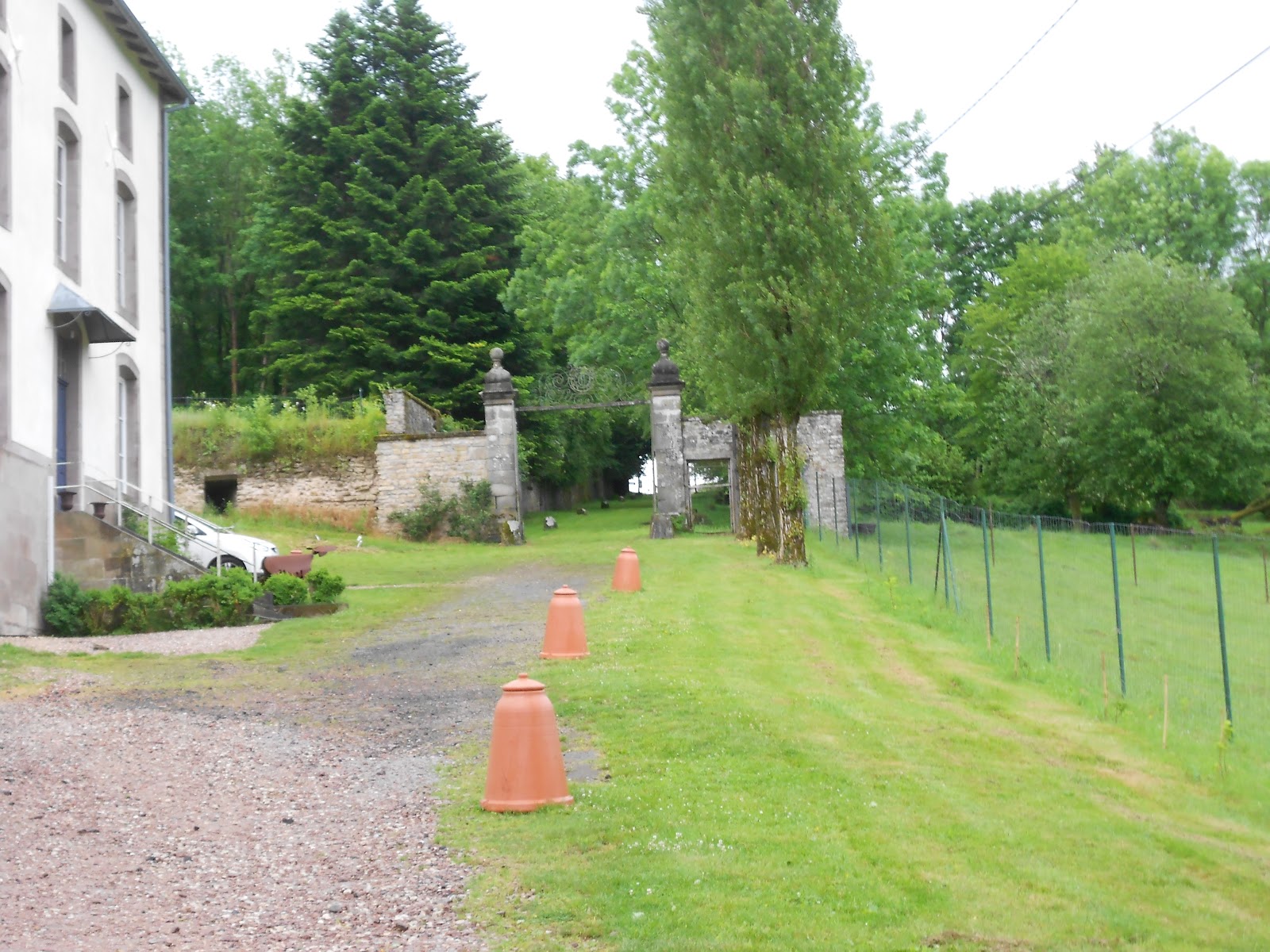
The small church where we actually performed was in fact just outside that town in an old industrial/tin manufacturing park/arboretum from the 18th century.  It was actually pretty cool, but I couldn't find out much about it despite wandering around and inquiring with people at random. 

It turned out that it was the people who now take care of the site who invited us to sing for part of a concert series at the church.  They live in the old "overseer's" place (I put that in quotes because I don't know what the actual title was), which was really interesting because it was a mix of old industrial stuff and modern house stuff.  They had two very fluffy, very sweet dogs. 


Some shots of the old factory area, which is now possibly a tour site but I'm not sure.


I'm guessing that the church on site was for the workers, which makes me in turn think it couldn't have been a very large industrial site.  The church was teeny, and even the people who came for the concert did not all have seats - some were even standing just outside the doors because there was no more room to come in.


Afterwards the hosts offered us a customary drink.  The room was down in the cellar (looked more like a dungeon) of the main house part, which looked and felt very old


So, back to Damelevieres quickly before I wrap up the Lorraine entries.   Due to some communication errors there was no one around to get me at the little train station in this little town when I arrived the day before the concert.  But since it is indeed little I was able to walk to my friend's house.  She directed me solely based on landmarks (the bridge, the church, the big field).

Here is my walk, in brief.


This graffiti on the bridge is in support of the French national soccer team (Les Bleu - the Blue[s], the team)


No clue what this is.  Maybe you can tell, but it might be too small: it's a couple pools of water, with a faucet at one end.  It reminds me of old Roman baths but it's too small and new and anyway, Romans weren't in this area.


Into the town!  It used to be a major railway stop, which is why it has those trains.


The only church in town is also the mossiest one I've come across.


And finally I got to the field, as shown in the last post on the town, which is right next to where they live.  It really is a charming place.

Sunday, June 10, 2012

Messe Rue

So I'm sitting here on a lazy Sunday afternoon minding my own business. My windows are open, I'm reading one of my favorite chapters from Les Miserables, and I'm humming along to Pink Floyd.

All of a sudden I become aware of someone speaking to a crowd through a microphone nearby - it's coming in my windows decently loudly.  I try to ignore it (today is a municipal election day so I thought it had something to do with that, since the main voting area for my arrondissement is just around the block) but it is pretty loud.  I stick my head out my bathroom window, which does not face the town hall but rather faces the river and Notre Dame cathedral, and I can hear the words more clearly.  I still can't make out a lot of them but get the idea that it's some kind of prayer.

Hmmm I think, we just had a couple of Catholic holidays that were unfamiliar to me (Pentecost and the Ascension) could there be another so soon?  Perhaps it's a Muslim holiday but the Paris Mosque is too far away for me to hear.

The guy who was just speaking starts to chant! Cool!  (Some might remember that I occasionally go to the Gregorian chant mass at Notre Dame on Sundays because I looove Gregorian chant.)  That rules out a Muslim or Jewish holiday but what is going on here?  And so loudly that at least 3-4 neighborhoods can hear it clearly?  I might add here that on Pentecost Notre Dame rang its bells for about four hours straight, so they're certainly not adverse to being loud.

I can't figure it out but it does put me out of the mood for Pink Floyd.  After searching Google for a good twenty minutes or so (sure I could have gone to check it out myself but you know, seven flights of stairs and a jaunt across the river is daunting just for the sake of curiosity) I find this: http://www.paris.catholique.fr/Festival-de-la-Rue-et-Messe-Rue-a.html

It's some kind of outdoor mass festival in the square outside Notre Dame, but for some reason the focus is on artists.  There are photographers, painters, comic designers, model makers...lots of stuff.  Also in a couple of hours there will be an "animated" mass as well as a comedic play based on the life of Saint Paul.  Not the funniest guy around but, uh, okay.

Anyway, this event isn't that significant but I wanted to illustrate something that happens here probably at least once a month: I hear some mysterious crowd noises, speeches, or music and it turns out that there is some very random festival happening in my neighborhood.  This happened with two consecutive weekends of a festival/parade of marching bands, a protest/parade of homeless people and their supporters, and of course some rallies surrounding the presidential election (which I will describe in more detail sometime later). 

For the record, the live chant is still going on.  I don't know how Parisian feel about this but I love it!

Nancy

As promised, here is a bit of what I saw in Nancy, both the first time I went and last weekend.  The concert went fine, I'll discuss that a bit more later.

I spent only half a day in the town of Nancy, but it's fairly small and compact so I did get to see a lot of things.  Unfortunately I didn't get to go to the art nouveau museum, which I really wanted to see.  Maybe next time.

Unlike a lot of the places in France I've visited (notably Rouen, Reims, Orleans, and Amboise) most of Nancy's important history is not medieval.  In fact it was only really founded in 1050 - I say ONLY because most cities here are considerably older, although to Americans that seems ancient - and has been rebuilt a few times due to being involved in several wars.

This area of France has probably changed hands more times than the east, which went back and forth between the English and French for centuries.  Nancy is in Lorraine, a territory that since the 13th century has been in the hands of the following, chronologically: Champagne (an independent vassal state of France at the time); the Holy Roman Empire (what we would now consider a "German" empire); disputed with Burgundy (another independent vassal state of France); occupied by France proper; the Hapsburg [Austrian] Empire; France again; Prussia [German empire]; France; Nazi Germany; finally France again.

Whew.  Suffice to say, this area has been disputed for a very long time and lots of battles have been fought over it. Nancy remained the capital of the region throughout all that.

Not too much has remained from the early days of the city, I'm guessing because of all the wars and occupiers.  Just a few gates of the historic city walls remain, such as this one:


You might notice the cross of Lorraine in the middle there from my visit to Normandy, where it stands to commemorate the arrival of General de Gaulle after D-Day.  It was adopted as the symbol of the Resistance. 

Much of the city seems to date from the late 18th/early 19th centuries, when Lorraine was firmly in French hands.  Visually it reminds me most of Bordeaux (I was going to link to my old post on Bordeaux here but realized I didn't put any pictures up!  I will later). 

The centerpiece of the town is the main square, the Place Stanislas, which boasts of being one of the most beautiful squares in Europe.  It is very pretty, well laid-out, and grand, but I don't know if I'd agree with them.  It has these, called the "golden gates" at each of the entrances:


The square is very large, with the town hall at one end, a statue of the former king of Poland (and father to Marie Leszczynskaya, queen of Louis XV - see my entry of the palace of Versailles) who owned Nancy in the later 18th century, the aforementioned Stanislas.  At the opposite end from the town hall is a really beautiful fountain, and next to that a mini Arc de Triomphe.  It's all very balanced and 18th century.


When I visited there was a jazz orchestra playing in the middle of the square.  Pretty cool!

 Just a few blocks away is the main cathedral of the city, in a style I haven't posted on here since I went to Italy!  It has more of the Italian 17th century style, very much not the Gothic stuff I usually show.  It's large and the altars are pretty ornate but you can tell it doesn't have the best upkeep: the frescoes are very dark and dirty (note the fresco in the shot of the ceilings), and a lot of the pieces of artwork have been removed.


I'm told the choir I sang with has performed here recently.

This section of the city is clearly a record of its most prosperous times: the streets are wide and neatly organized, the buildings are all the typical tan stone townhouse styles that you can see all over Paris and Bordeaux.  It's easy to imagine rich bourgeois ladies sweeping through the avenues in their huge 18th century dresses.

On the other side of the square, however, is evidence of a more provincial and medieval lifestyle.  The roads get narrower, the buildings are a mix of architecture from medieval to modern, some streets are still cobblestone.  Personally I like these areas better, so I strolled along trying to get a feel for the different periods in the town's history.  I didn't know a lot specifically about the history of Nancy or what I wanted to do there so I was discovering a lot of things as I went along.

I came across this church from the back, and was surprised to see something that looked authentically Gothic (ie, medieval) and didn't seem to be advertised in the tourist stuff I'd picked up.


Coming around to the front you can see a huge difference in color of the stone: above it is pretty typical of Gothic churches, somewhat dirty and weather-beaten, a dull off white or tan; below it's clean and pristine, the color I generally see when casts have replaced original statues and details (like in my entry on the cathedral at Reims).


So I figured it had probably been cleaned recently, and also replaced sometime in the 20th century.  Imagine my surprise upon going inside and reading that this church is actually from the mid 19th centrury!  Oops.  I was pretty embarrassed, as someone who is an amateur of Gothic art and architecture, that I didn't recognize it as a late copy.  It's really authentic though, I've never seen one replicate Gothic styles this closely!

The stained glass is all clearly modern though.  Very beautiful, especially because I went just as the sun was shining through the western windows.


 Anyway, this church was kind of on the border between the 18th century part of the city and the part that comes from the next important period for Nancy: late 19th/early 20th century, when it was the center of the Art Nouveau movement.  Lots of the buildings and windows in this section have cool little art nouveau and art deco details.


Many of the artists who began the shift into modern art styles were at the school of fine arts in Nancy, and were influenced by both French and German traditions here.  They have a great art nouveau museum that I really want to see.

There is a really large, lovely, park from this period as well.  I was getting tired from all the walking and decided to take a break there.  


I knew it had a pretty famous rose garden area:


But I did not know that it also has a Rodin sculpture just hanging out in the middle!


It is of some historical guy who did something notable here - I want to say he was a duke or something who fought in one of the later medieval battles.  Anyway, he's not the important part, look at the base of the statue.

So those are the things I made a point to go see, but I spent most of the time just walking around the town.  I had missed the earlier train I intended to take so didn't have as much time as I wanted.  I'm going back at the end of June, though, so hopefully I can see more then. 

Here are a bunch of pictures from just walking around:


This street below leads to the Place Stanislas, and features the high end shopping area of the town, which is pretty impressive (even coming from someone who lives in Paris!):


A pretty little park:


From the more medieval area:


From the bourgeois 18th century area, here is a provincial example of the "palaces" rich people used to build in that period.  I discussed them more in my post on the 3rd arrondissement of Paris.


And as I walked back to the train station I spied this plaque bearing Thomas Jefferson's head.  It commemorates the time he was an ambassador to France immediately before the French Revolution, and talks a bit about the exchange of democratic ideas between the two countries in that period.  It doesn't mention Nancy in particular, though, so I have no clue why it was on that building.


Next post: a bit about the concert and the place we performed.