I got an email today from a business that emails me regularly with updates and deals. It advertised the following "bons plans," or "good ideas":
38 Euro round trip flight to Venice
37 Euro round trip to Marseille
52 Euro round trip to Berlin
76 Euro round trip to Casablanca (Morocco), from Lyon
108 Euro 5 night trip to Marrakesh (Morocco), including flight and hotel
101 Euro 5 night trip to Budapest, same thing
102 Euro, same thing to Libson (Portugal)
114 Euro, same thing to Madrid
And more.
Let me tell you, if I had someone to take with me I would be going to Marrakesh this weekend. Literally the only thing stopping me from doing that is because, for safety reasons, I hesitate to go to Morocco without a guy.
I thought I'd share this because often Americans are either baffled or very impressed by my tendency to travel around, last minute, on my own. It's really not hard here to plan a quick, safe trip to another country for a very low price. There are budget airlines to get to farther-away places, and fast, efficient trains to go places nearby. They often also have student and/or young people deals. Every major city also has student/young people hostels which are safe and very cheap. Finally, most major cities here have great public transportation to get around easily once you end up there.
One must also keep in mind that European countries are generally impossibly tiny compared with what Americans are used to: excluding Russia, France is the third largest country in Europe (after Turkey and Ukraine) and is smaller than Texas. The Netherlands, for example, towards the small side but still a popular destination, is bigger than Maryland but smaller than West Virginia - it's about 16,000 square miles.
So when I pop over to London for a weekend, that is about 285 miles by train; to Brussels is less than 200 miles; to Berlin is about 620 miles.
It's easy, convenient, and quick to travel around Europe once you're already here; it's not much different from my traveling to Boston or Washington DC from NYC if I wanted to. And with knowing English and French, I can communicate pretty much anywhere I might go.
I guess for some people it would be difficult to travel to a new, foreign city alone. I don't really have a reason for being comfortable with that, other than that I've been doing it a long time, I've done it enough to know what to do/what not to do, and generally I prefer traveling alone, anyway. It lets me do exactly what I want to do.
And you can see how tempting it is to go around when I get emails with deals like that all the time!
Showing posts with label International travel. Show all posts
Showing posts with label International travel. Show all posts
Wednesday, September 19, 2012

Thursday, June 14, 2012
Milan part 2
Finally going on a bit in my Milan adventure to more modern times! Here are two statues of remarkable 19th century Italian men: they both played huge roles in establishing an Italian national identity (as I mentioned before, Italy did not exist as a country or an idea until around their time) and Italians love them.
The first here is Garibaldi, a general and nationalist, is probably one of the most admired figures in Italian history. His charisma and ability to rally the Italian people around a common cause made unification possible in the minds of Italians. The Milanese like to dress up his statue for fun.

And here is Victor Emmanuel, the only ever "king of Italy" to rule the whole of the modern country. Although he successfully united the peninsula, he never really had the power of a king. His reign saw Mussolini rise to power and he couldn't really do anything to stop it. I'm not that clear on why he's so fondly remembered by the Italian people, but they really like him.

Now back to ancient history. This is La Scala, Milan's famed opera house! It was much smaller than I expected (as someone who has studied opera La Scala looms large as second only to the Paris Opera on the list of places to go when you've hit the big time) but it and the little square around it are really lovely. The statue in the middle is da Vinci.


Here is the church of Maria della Grazie, whose main claim to fame is that da Vinci's Last Supper is inside. It's still a functioning convent and it's small but really pretty and light inside. I loved this church.


This is the refectory of the church, where the Last Supper is painted on one of the walls. A refectory is like a cafeteria for monks - get it, the Last Supper in a cafeteria? Unfortunately I didn't know until I got to Milan that you have to book a spot like, months in advance to see the painting, so I couldn't go in. I guess the place is pretty small and they have to control visitors.

The Sforza coat of arms on the side of the church:

Finally we come to the main church I had wanted to visit in Milan, the ancient basilica of Sant'Ambrogio, or St Ambrose who I mentioned before. St Ambrose is one of the "Church Fathers" who were extremely intelligent, learned, influential men in the early days of the Catholic Church. They are the ones who established most of the still current Christian theology, and Ambrose is probably the most significant of them. To me they're most important as philosophers of their time - they actually worked with the ideas of Plato and Aristotle and put them into their religious worldview. They weren't opposed to science and religion together as so many medieval (and to tell the truth, modern) church men and theologians were.
Anyway, some parts of this church date back to the 4th century but most of it is from the 12th.


One of my big missions in Italy was to see some of the phenomenal Byzantine mosaics in the old churches, having been really impressed by them on my visit to Istanbul in 2006. Here is the main one in this church, an extraordinary example of art of the time. I can't begin to describe how these mosaics are in person: they're delicate and intricate, with amazing detail and symbolism, and lines of gold are woven throughout. They're much closer to the icons of Eastern and Greek Orthodox traditions - but remember, when these were created there had no yet been a schism between the Roman Catholic Church and the Eastern Orthodox branches. There was only one Christian church. Once I get the pictures of Ravenna I'll put up the most amazing ones I've ever seen.
This mosaic is a Christ Pantokrator, which is usually translated as Christ the Sustainer of the World. Just basically an idea of all-powerful-ness.

Finally, a trip through the treasury of this basilica was really interesting. It still has tons of priceless art and artifacts belonging to the Church.

And below the church, in the vaults, still lies the body of St Ambrose, who died in 397. More than 1600 years later he looks rather mummified, but you can still make out a lot of the features. He's dressed like a bishop of the time, with grand, intricately decorated robes, and is shown in a glass case.
I do have a picture of him on my old computer, but since it is rather gross I don't think I'll post it.
So now I've put up all the important pictures I have access to for Milan, and you'll have to wait until next month for stuff from the rest of the trip and from Bordeaux. Again I apologize for the not-great-quality pictures, but I hope you enjoyed it anyway!
The first here is Garibaldi, a general and nationalist, is probably one of the most admired figures in Italian history. His charisma and ability to rally the Italian people around a common cause made unification possible in the minds of Italians. The Milanese like to dress up his statue for fun.

And here is Victor Emmanuel, the only ever "king of Italy" to rule the whole of the modern country. Although he successfully united the peninsula, he never really had the power of a king. His reign saw Mussolini rise to power and he couldn't really do anything to stop it. I'm not that clear on why he's so fondly remembered by the Italian people, but they really like him.

Now back to ancient history. This is La Scala, Milan's famed opera house! It was much smaller than I expected (as someone who has studied opera La Scala looms large as second only to the Paris Opera on the list of places to go when you've hit the big time) but it and the little square around it are really lovely. The statue in the middle is da Vinci.


Here is the church of Maria della Grazie, whose main claim to fame is that da Vinci's Last Supper is inside. It's still a functioning convent and it's small but really pretty and light inside. I loved this church.


This is the refectory of the church, where the Last Supper is painted on one of the walls. A refectory is like a cafeteria for monks - get it, the Last Supper in a cafeteria? Unfortunately I didn't know until I got to Milan that you have to book a spot like, months in advance to see the painting, so I couldn't go in. I guess the place is pretty small and they have to control visitors.

The Sforza coat of arms on the side of the church:

Finally we come to the main church I had wanted to visit in Milan, the ancient basilica of Sant'Ambrogio, or St Ambrose who I mentioned before. St Ambrose is one of the "Church Fathers" who were extremely intelligent, learned, influential men in the early days of the Catholic Church. They are the ones who established most of the still current Christian theology, and Ambrose is probably the most significant of them. To me they're most important as philosophers of their time - they actually worked with the ideas of Plato and Aristotle and put them into their religious worldview. They weren't opposed to science and religion together as so many medieval (and to tell the truth, modern) church men and theologians were.
Anyway, some parts of this church date back to the 4th century but most of it is from the 12th.


One of my big missions in Italy was to see some of the phenomenal Byzantine mosaics in the old churches, having been really impressed by them on my visit to Istanbul in 2006. Here is the main one in this church, an extraordinary example of art of the time. I can't begin to describe how these mosaics are in person: they're delicate and intricate, with amazing detail and symbolism, and lines of gold are woven throughout. They're much closer to the icons of Eastern and Greek Orthodox traditions - but remember, when these were created there had no yet been a schism between the Roman Catholic Church and the Eastern Orthodox branches. There was only one Christian church. Once I get the pictures of Ravenna I'll put up the most amazing ones I've ever seen.
This mosaic is a Christ Pantokrator, which is usually translated as Christ the Sustainer of the World. Just basically an idea of all-powerful-ness.

Finally, a trip through the treasury of this basilica was really interesting. It still has tons of priceless art and artifacts belonging to the Church.

And below the church, in the vaults, still lies the body of St Ambrose, who died in 397. More than 1600 years later he looks rather mummified, but you can still make out a lot of the features. He's dressed like a bishop of the time, with grand, intricately decorated robes, and is shown in a glass case.
I do have a picture of him on my old computer, but since it is rather gross I don't think I'll post it.
So now I've put up all the important pictures I have access to for Milan, and you'll have to wait until next month for stuff from the rest of the trip and from Bordeaux. Again I apologize for the not-great-quality pictures, but I hope you enjoyed it anyway!
Tuesday, June 12, 2012
Blast from the past - Milan part 1
I recently realized that when I did this a few years ago I was scandalously remiss in posting pictures from my trip to Italy, and also some of my French adventures. Unfortunately I have gotten a new computer since then and nearly all of my pictures from those trips are on my old computer, which is in NY. All I have on hand are the pictures I posted on Facebook from Milan. However when I go back to NY in July I will transfer my older albums to this computer so I can finally show them off.
Just note: the camera I used for these pictures was not very good, so the quality isn't great. Also I couldn't figure out how to turn off the stupid date stamp. Keep in mind that one of the primary goals on this trip was to check out lots of church art and architecture so there will be an overwhelming amount of that here.
Okay! Onward. Milan was my first stop in a tour of five Italian towns and cities that I visited for my spring break in 2008. I believe I ended hitting all my main stops here in the three days I had.
Milan is pretty well known I suppose, but I'll give a bit of background. It's a very old city, with evidence of pre-Roman settlements. It's had three main important historical periods: it was a place of religion and learning in the 4th century AD, under the influence of the renowned Church Father St Ambrose; it was a main center of the Italian Renaissance under the patronage of the Sforza family in the 15th and 16th centuries, and finally it was an area of political dispute and turmoil in the 19th century. I'll touch on things from all these periods but it would be a bit ridiculous to try to get through everything.
An important thing to note is that Italy was not unified as a country until the late 1800's. It was split into independent city states that were ruled by very wealthy dukes who rarely started out as royalty - they generally bought their way into power and consolidated it by a combination of power, intimidation, and patronage. This political system is what paved the way for the Italian Renaissance, as the families tried to outdo each other culturally as well as politically, and tried to keep up with the royal houses of Europe. In doing this they poured tons of money into supporting famous artists to make works for them.
One of my first stops was the Ambrosiana Library, one of the oldest and most renowned archives in the world. My nerd excitement meter was through the roof here! Not only does this place have sketches and paintings from tons of great Italian artists like da Vinci (it also has some of his notebooks and manuscripts), Raphael, Botticelli, and Caravaggio, it also has a ton of ancient texts, from Aristotle to some first copies of the gospels. There is just such a wide range of things here I can't begin to list them all. Many of the manuscripts and texts are not open to the public, but the windows into the library galleries are glass. I spent a good few minutes just staring through these windows, wondering what rare and amazing books I was looking at.

Unfortunately pictures weren't allowed inside the museum part when I was there.
This is a bank I came across just walking around. It looks like a Renaissance bank but the coat of arms isn't Medici so I'm not sure who this belonged to. Banks, as well as political power, were generally tightly controlled by wealthy families who would display their coat of arms prominently on all the buildings they commissioned.

I had no clue what this building was but it's pretty typical of the Renaissance style mini-palaces around Italy.

The ruling family of Milan at the height of the Renaissance were the Sforzas. Although the Medici and Borgias are probably the most well known of the Italian mafia-like ruling families, the Sforzas were similar in their power and influence; they patronized da Vinci and Michelangelo amongst others. The notorious Lucrezia Borgia married a Sforza.
Their castle still exists in Milan and is now a pretty incredible Renaissance museum. It was started in the mid 15th century and ended up being one of the biggest citadels in Europe.


Here are the grounds of the castle:


Inside the museum is a mixture of artifacts gathered from elsewhere and things that are part of the castle itself.
Here is an arch taken from an old Medici bank:

A bunch of cool swords:

Michelangelo's unfinished Pieta Rondanini - the difference in styles between this and his earlier idealized neo-Classical works is striking.
 Here is a ceiling in the castle that was painted by da Vinci. Although I wasn't able to get a great shot of it (the colors are pretty off and I have nothing of the trunks of the trees, more towards the side of the ceilings) this picture is not out of focus. He had done a number of trees with their leaves meeting at the high center of the ceiling, with the Sforza coat of arms in the middle.


The square in front has tons and tons of pigeons!

Inside the church is absolutely huge, and quite dark. None of my pictures here came out very well, but it gives a decent impression of the gloomy, rather oppressive atmosphere. It's much more cheerful from the outside.

The pattern on the floor - the colors, again, are off, but you can get the idea.


A side altar:

This cathedral felt extremely touristy and impersonal to me. You can read my original entry on Milan, linked above, but I still remember the rather flat feeling it gives off - as opposed to somewhere like Notre Dame, which is also big, imposing, darkish, and very touristy. It is really lovely, but there is a sense of intimidation rather than general awe or splendor.
There's also a pretty gruesome sculpture of St Bartholomew, who I guess was skinned alive, because it shows him walking, having been flayed, carrying his own skin over his shoulder. My picture didn't come out very well at all.
I'll end with a few shots of San Lorenzo Basilica, which I did not get to enter. It has a big and lovely park outside. This is a particularly old church, having probably been founded around the time of St Ambrose in the 4th century. It has changed over the centuries, but is still overwhelmingly Byzantine/Romanesque. You can see it's not Gothic at all, with simpler, cleaner lines based on domes and rounded arches. I believe it was renovated in the 1500's, but I think it has kept its original outlines.


More to come!
Just note: the camera I used for these pictures was not very good, so the quality isn't great. Also I couldn't figure out how to turn off the stupid date stamp. Keep in mind that one of the primary goals on this trip was to check out lots of church art and architecture so there will be an overwhelming amount of that here.
Okay! Onward. Milan was my first stop in a tour of five Italian towns and cities that I visited for my spring break in 2008. I believe I ended hitting all my main stops here in the three days I had.
Milan is pretty well known I suppose, but I'll give a bit of background. It's a very old city, with evidence of pre-Roman settlements. It's had three main important historical periods: it was a place of religion and learning in the 4th century AD, under the influence of the renowned Church Father St Ambrose; it was a main center of the Italian Renaissance under the patronage of the Sforza family in the 15th and 16th centuries, and finally it was an area of political dispute and turmoil in the 19th century. I'll touch on things from all these periods but it would be a bit ridiculous to try to get through everything.
An important thing to note is that Italy was not unified as a country until the late 1800's. It was split into independent city states that were ruled by very wealthy dukes who rarely started out as royalty - they generally bought their way into power and consolidated it by a combination of power, intimidation, and patronage. This political system is what paved the way for the Italian Renaissance, as the families tried to outdo each other culturally as well as politically, and tried to keep up with the royal houses of Europe. In doing this they poured tons of money into supporting famous artists to make works for them.
One of my first stops was the Ambrosiana Library, one of the oldest and most renowned archives in the world. My nerd excitement meter was through the roof here! Not only does this place have sketches and paintings from tons of great Italian artists like da Vinci (it also has some of his notebooks and manuscripts), Raphael, Botticelli, and Caravaggio, it also has a ton of ancient texts, from Aristotle to some first copies of the gospels. There is just such a wide range of things here I can't begin to list them all. Many of the manuscripts and texts are not open to the public, but the windows into the library galleries are glass. I spent a good few minutes just staring through these windows, wondering what rare and amazing books I was looking at.

Unfortunately pictures weren't allowed inside the museum part when I was there.
This is a bank I came across just walking around. It looks like a Renaissance bank but the coat of arms isn't Medici so I'm not sure who this belonged to. Banks, as well as political power, were generally tightly controlled by wealthy families who would display their coat of arms prominently on all the buildings they commissioned.

I had no clue what this building was but it's pretty typical of the Renaissance style mini-palaces around Italy.

The ruling family of Milan at the height of the Renaissance were the Sforzas. Although the Medici and Borgias are probably the most well known of the Italian mafia-like ruling families, the Sforzas were similar in their power and influence; they patronized da Vinci and Michelangelo amongst others. The notorious Lucrezia Borgia married a Sforza.
Their castle still exists in Milan and is now a pretty incredible Renaissance museum. It was started in the mid 15th century and ended up being one of the biggest citadels in Europe.


Here are the grounds of the castle:


Inside the museum is a mixture of artifacts gathered from elsewhere and things that are part of the castle itself.
Here is an arch taken from an old Medici bank:

A bunch of cool swords:

Michelangelo's unfinished Pieta Rondanini - the difference in styles between this and his earlier idealized neo-Classical works is striking.


Moving on to what is probably the most well known landmark in Milan: the Duomo. This is the fourth largest cathedral in the world, and largest in Italy (although I believe St Peter's in Vatican City is bigger). It took an unusually long time to build - 600 years - and was started in the 1380's, in a flamboyant Gothic style. It's certainly one of the most ornate churches I've seen, and the stone used is pretty distinctive.


The square in front has tons and tons of pigeons!

Inside the church is absolutely huge, and quite dark. None of my pictures here came out very well, but it gives a decent impression of the gloomy, rather oppressive atmosphere. It's much more cheerful from the outside.

The pattern on the floor - the colors, again, are off, but you can get the idea.


A side altar:

This cathedral felt extremely touristy and impersonal to me. You can read my original entry on Milan, linked above, but I still remember the rather flat feeling it gives off - as opposed to somewhere like Notre Dame, which is also big, imposing, darkish, and very touristy. It is really lovely, but there is a sense of intimidation rather than general awe or splendor.
There's also a pretty gruesome sculpture of St Bartholomew, who I guess was skinned alive, because it shows him walking, having been flayed, carrying his own skin over his shoulder. My picture didn't come out very well at all.
I'll end with a few shots of San Lorenzo Basilica, which I did not get to enter. It has a big and lovely park outside. This is a particularly old church, having probably been founded around the time of St Ambrose in the 4th century. It has changed over the centuries, but is still overwhelmingly Byzantine/Romanesque. You can see it's not Gothic at all, with simpler, cleaner lines based on domes and rounded arches. I believe it was renovated in the 1500's, but I think it has kept its original outlines.


More to come!
Thursday, January 26, 2012
5th arr, continued
The headquarters of the Sorbonne, or the University of Paris, is in the area of St Michel, but its buildings are spread throughout the 5th. Most people outside of France believe that the Sorbonne, because it is the oldest and most famous university in France, is also the most prestigious, but this is not true; there are three other schools off the top of my head that I can think of that are significantly harder to get into and have more impressive recent graduate lists (and two of those three also happen to be based in the 5th arr). So, the Sorbonne is kind of France's Cornell. *Sidenote - it is actually incorrect to call this set of affiliated schools "the Sorbonne" - it is more accurately the Universite de Paris. Students will say they go to "Paris I-VII" - each school has a different area of academic emphasis. I myself was in Paris I, which is based around social sciences/humanities.

However, the Sorbonne's establishment in this area in the 12th century set a precedent for this as the center of education in France. Just a little south and east of the Place St Michel it seems like every fourth building is affiliated with one of the many universities or prep schools here - this is the area I live in. As I've mentioned, I live on the same block as one of the main libraries of the Sorbonne, which is is turn next to the Sorbonne's law school, and next to the library is a prestigious grade school. Just around the block from these are the two most competitive prep schools in the country. The main polytechnic school in the country and the ENS, from which most of the top levels of government recruit their people, are also right around me. In the middle of all this sits the Pantheon (no pics for that since I feel I've overloaded this blog with pics of the Pantheon).
So I suppose it's probably easy to see how, with all these higher education institutions around, nearly every artist, writer, or philosopher you've ever heard of who lived in Paris at some point probably lived here. Just in the 20th century a few of the famous residents of the 5th: Ernest Hemingway, F. Scott Fitzgerald, Gabriel Garcia Marquez, J-P Sartre, Oscar Wilde, James Joyce, Gertrude Stein, Allen Ginsberg, William S. Burroughs, sculptor Rodin, Picasso...the list goes on and on. Small wonder the 5th is known for its bohemian/artsy way of life. The recent Woody Allen movie "Midnight in Paris" is basically all about the 5th and its inhabitants - for those who have seen it, the place where he catches the car at night is in fact the corner of my street, Rue la Montagne St Genevieve, and the Place du Pantheon.
Running from what I'm categorizing as "the rest" of the 5th and the "educational" part of the 5th is the ancient Rue Mouffetard. You might remember that in the summer I lived a block away from this street. There is evidence that this road was used by the Romans, and possibly was established before they came into France.

Today it is another main tourist stop, being that it is cute, mostly pedestrian, and absolutely covered in good restaurants/fast food places and good shopping. You can follow the Rue Mouffetard right from the Pantheon, through the Place Contrescarpe, a favorite break-time spot covered with cafes for students to grab a glass of wine or coffee between classes, south towards "the rest" of the arr, where at the bottom of the road is the adorable medieval church St Medard and an every day fruit market.

A couple blocks from this church is the Grande Mosque de Paris, the main mosque of the city. In the springtime the garden of the mosque is one of the most beautiful, peaceful places to sit and read with a cup of tea, I absolutely love it. A bit farther on is the Jardin des Plantes, a park that was set up by botanists to display various types of plants and also included the only zoo-type thing in the city. The garden itself is really lovely - very wild and haphazard unlike the very sculpted and composed gardens in the rest of the city.
This area, though, is far more residential and non-touristy than the rest of the arr: very few tourists will venture past the end of the Rue Mouffetard.
***
I love living in this neighborhood and probably would rather live here than anywhere else in the city. It's such a great mix of people, has great museums and bookstores, has a good balance of famous monuments, more obscure sites, and everyday things. Many others have described the Latin Quarter far better than me, so if it interests you just dig a little deeper to find out more!
Tuesday, January 24, 2012
5th arr
Or as I call it, home! The 5th arr is better known to the outside world as the Latin Quarter, though here it's more often known as "the Pantheon," and it's been well-known for its population of writers, artists, and students for centuries. It's our first foray into the Left Bank, which is more artsy and less chic than the Right Bank. Being that it is my neighborhood, I've already written up several posts having to the with the 5th: the Roman ruins, the streets immediately around me and the background of the Pantheon itself, and about half of this walking tour post pertains to the 5th.
So as I discussed a while back, this area was one of the very first areas of Paris that was settled. We know that there was a Gallo-Celtic tribe (the Parisii, after whom the city is now named) before the Romans, but we don't know too much about them. But we do obviously know a lot about the Romans - see that first post I linked to see the Roman amphitheater that's not too far away from me. There are also ruins of an ancient Roman bath just a couple of block from me, on top of which the Cluny monastery was built in the Middle Ages. Wikipedia claims that the 5th is the oldest arr but I am not sure that's true. It seems in my other research that the Ile-de-la-Cite, now shared between the 1st and 4th, is the oldest, but whatever.
Anyway, moving a bit ahead in time, the 5th was probably the most important arr in the city from the early to late Middle Ages in terms of your average citizen. While the government was based across the river in the 1st arr, the 5th had a truly lively and diverse population, with lots of businesses, but more importantly lots of early churches and schools. It defined the intellectual society of Europe at that point in time, and was home to the most important names in philosophy, theology, and the arts.
Why is it called the Latin Quarter, you might ask? Well, precisely because of the large percentage of the medieval population here that either were involved in the clergy (and therefore spoke Latin a lot) or in higher education/were students (and therefore spoke Latin a lot). The Latin language was so predominant that I would venture to guess if you lived here in, say, the 13th century, you'd hear it at least as much as the colloquial French of the time.
I've tried to think of several different ways to structure this post so that you can follow it easily, but it's hard to figure out how to cover the 5th in a logical manner. I could go chronologically but I think that would get a bit confusing in terms of the modern space. I could go geographically but that might get chronologically confusing. I could go thematically but that would be both chronologically and geographically confusing. So I have chosen to split up the arr into three sections: first, the now-tourist-area around St Michel; the university area (though those overlap quite a bit); and the rest. I apologize if it gets a bit confusing, but there is a lot to cover here!
So, St Michel. Whenever someone comes to visit Paris inevitably something in this area is on their list of must-see places, because it's historically important and interesting, one of the most picturesque areas of the city, and it's a very central location. It's probably best to do this area chronologically.
The Place St Michel, which is a very pretty few blocks somewhat marred by kitschy tourists shops, is just across the river from Notre Dame cathedral. Its central feature is this mid 19th century fountain, representing a "Peace" figure.

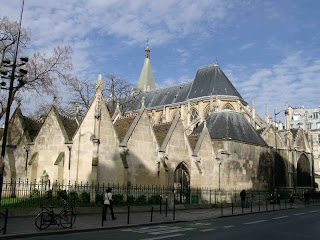
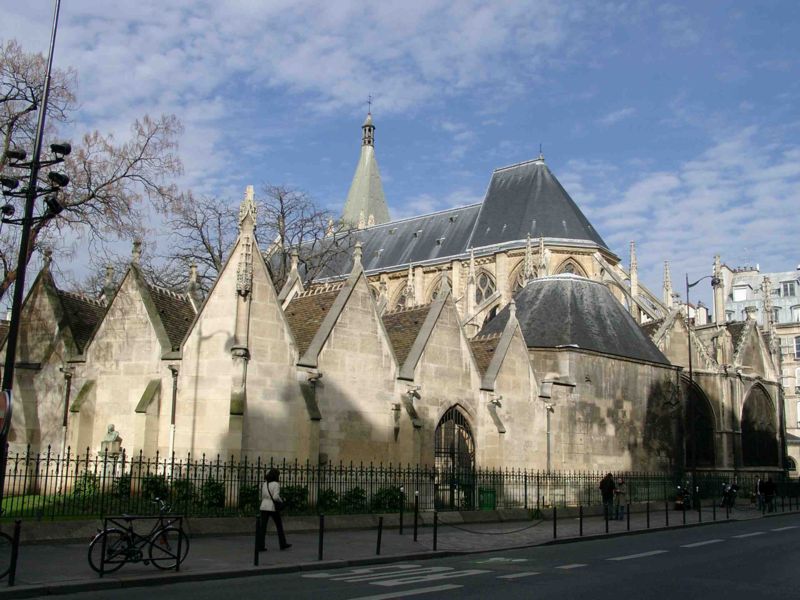
Right around the corner from that is St Severin, my personal favorite church in the city. It's high Gothic but not as gaudy as most from the time, holds the crushed finger bones of St Ursula (fun!), has a mixture of medieval and modern stained glass, and one of its columns is randomly shaped like a palm tree. I should find my old pictures of it, but here is the outside.
So as I discussed a while back, this area was one of the very first areas of Paris that was settled. We know that there was a Gallo-Celtic tribe (the Parisii, after whom the city is now named) before the Romans, but we don't know too much about them. But we do obviously know a lot about the Romans - see that first post I linked to see the Roman amphitheater that's not too far away from me. There are also ruins of an ancient Roman bath just a couple of block from me, on top of which the Cluny monastery was built in the Middle Ages. Wikipedia claims that the 5th is the oldest arr but I am not sure that's true. It seems in my other research that the Ile-de-la-Cite, now shared between the 1st and 4th, is the oldest, but whatever.
Anyway, moving a bit ahead in time, the 5th was probably the most important arr in the city from the early to late Middle Ages in terms of your average citizen. While the government was based across the river in the 1st arr, the 5th had a truly lively and diverse population, with lots of businesses, but more importantly lots of early churches and schools. It defined the intellectual society of Europe at that point in time, and was home to the most important names in philosophy, theology, and the arts.
Why is it called the Latin Quarter, you might ask? Well, precisely because of the large percentage of the medieval population here that either were involved in the clergy (and therefore spoke Latin a lot) or in higher education/were students (and therefore spoke Latin a lot). The Latin language was so predominant that I would venture to guess if you lived here in, say, the 13th century, you'd hear it at least as much as the colloquial French of the time.
I've tried to think of several different ways to structure this post so that you can follow it easily, but it's hard to figure out how to cover the 5th in a logical manner. I could go chronologically but I think that would get a bit confusing in terms of the modern space. I could go geographically but that might get chronologically confusing. I could go thematically but that would be both chronologically and geographically confusing. So I have chosen to split up the arr into three sections: first, the now-tourist-area around St Michel; the university area (though those overlap quite a bit); and the rest. I apologize if it gets a bit confusing, but there is a lot to cover here!
So, St Michel. Whenever someone comes to visit Paris inevitably something in this area is on their list of must-see places, because it's historically important and interesting, one of the most picturesque areas of the city, and it's a very central location. It's probably best to do this area chronologically.
The Place St Michel, which is a very pretty few blocks somewhat marred by kitschy tourists shops, is just across the river from Notre Dame cathedral. Its central feature is this mid 19th century fountain, representing a "Peace" figure.

The immediate area around the fountain, and just next to the river, has more medieval religious structures than you can shake a stick at. A couple of blocks away is St Julien le Pauvre, which claims to be the oldest church is Paris. I tend to believe it just based on architecture.

And right around the corner from St Severin hides my favorite bookstore in the city, the Abbey bookshop, run by a nice older Canadian man, and built atop the medieval vaults of the Cluny abbey. Of course, the remains of the Cluny abbey itself (and one of the best museums in Paris, I must say), are at the next block.
The Cluny abbey probably the most important monastery in medieval Paris, and many of its affiliated men were amongst the first staff of the Sorbonne, including Abelard (of Heloise and Abelard fame - if you don't know them, look it up, they have a great story and are probably one of the most intelligent and interesting couples in history). There were also extremely rich and politically influential, and they owned much of the land in this immediate area. St Michel was probably the most intellectually significant few blocks in all of Europe during the Middle Ages, and I really can't say enough how interesting this area is to any historian.
Many centuries later, in the 1968, St Michel was also the site of most of the student/popular demonstrations in Paris. I've told a lot of people about the French tendency to build barricades and protest things; I've also told the story of how in 1968 the government of Paris decided to remove cobblestones from some streets because they were being dug up to throw at police during the 60's demonstrations. This is true: during the manifestations of 1968 young Parisian students ripped up some of the cobblestones from the streets and used them as projectiles - not as building block of barricades as they had in times past. The government decided that nostalgia was less important than their immediate safety, I suppose. Nearly all of those streets were around St Michel - I believe the primary offender was the Boulevard St Michel itself.
Anyway, tourists love this area because of its tiny and mostly cobblestone streets, authentic medieval buildings, and monuments every other block. I love it because despite it being rather overrun with tourists there are some great out-of-the way, quiet, special places, like the Abbey bookshop, a Lebanese creperie on the Rue St-Andre-des-Arts, the Oubliette jazz club with the guillotine, and countless little cafes.
Monday, May 19, 2008
st jean de luz
For our final day, Sunday, we took a very early train out to St Jean de Luz, and got there around 7:15am. Perhaps you can imagine what a small French town looked like at 7:15am on a holiday Sunday: completely uninhabited. This was good in a way, as we got pics of the town without people in the streets and such (though I have not gotten those yet) but at the same time, we could not even find a place to eat. We walked through pretty much the whole town - it didn't take long - and took note of some shops we wanted to visit and places we might go.
The whole reason we went to St Jean de Luz, however, was to go up a nearby mountain on a train Holly recommended, and at the top there is an even smaller, more Basque town peopled mostly by shepherds. She said they are really friendly and will hang out with tourists and drink beer. However, since it was Pentecost, the trains were not running often and the schedules did not work out in our favor. At first we were really disappointed by this, but when we saw how cool the town was, it was okay.
St Jean de Luz is a small, very old beach town that is both gorgeous and quaint. It has a medieval look, and yet it is a type of medieval I was completely unfamiliar with: it did not feel like France, Spain, or even Italy or Germany, but something distinct. Basque, I suppose. Nearly all the buildings had red and green - Basque colors - prominently incorporated in the architecture, and again there was that strange, almost German style. You can also see the typically Basque geometric embellishments on most buildings.
The town used to be more important than it is now, because it was a convenient port. Louis XIV (Versailles, Sun King) got married to Maria Theresa of Spain here, as it is really close to the Spanish border. The house he stayed in still has some of its rooms set up as they were when he was there, and it is a neat little museum. The composer Ravel also grew up there.
So after checking out the town for a while we saw things slowly start to open; we were particularly interested in a market we had seen earlier. We decided rather than finding a boulangerie or something for breakfast we'd go through the market, grab a feast of traditional Basque food, and have a picnic on the beach. All the vendors were really nice when we asked them about the crazy-sounding Basque dishes, and I got many compliments on my French. Our feast consisted of: 2 types of paella (one that had a lot of whole sea animals in it), 2 types of Basque cheese (delicious!), bread, a type of potato salad, a veal salad-thing, mini gateaux Basque in both plain and the traditional black cherry flavor (a dessert, sort of like a cross between pound cake and cheesecake, something I can't remember! and some Basque wine. My friend took pics of all the food; when I get them I'll put them up.
By the time we finished our brunch-feast, everything was pretty much open. Walking back into the center we couldn't believe it was the same town: the streets were filled with people, the cafes crowded, and vendors had set up their wares on the sidewalks. It was also gorgeous by then, so we were content to just stroll around. I really wanted to see the cathedral where Louis XIV was married, so we made our way there. As we rounded the corner there were suddenly hordes of people lined up, waiting and watching the cathedral entrance, and lots of little girls dressed up in outfits similar to those flamenco dancers wear.
We were thoroughly confused for a few minutes until I started to listen to the music coming from the cathedral. It was a Latin prayer set to contemporary gospel-meets-Spain music; I realized this was all part of the Pentecost celebration. The French are big on Pentecost, I'm not sure why. Anyway, a few minutes later we saw a parade wind its way through the main road, with people in traditional costumes (big red dresses with large ruffles, suits with swords) riding horses and girls and women doing little dances in the street. It was really entertaining, but there were so many people we decided to walk along the beach instead, to a very green hill we had seen before. You can kind of see what I mean in this picture:

So we ambled along the coast, stopping at the curious "Festival of Pubs", and climbed the hill. It was a green I've only seen in Ireland and had amazing views of the harbor.


The grass was so enticing that I took a while just chilling out on the side of the hill (I was not actually sleeping - this is mostly to emphasize the peacefulness of the whole area)


And we had some fun taking pseudo-artsy shots

But by the time we came back down it was time to catch our train back to Paris. It was a REALLY long train ride, about 6.5 hours, and I had a final the next day. But it was such a great trip it was worth it to spend the weekend there!
The whole reason we went to St Jean de Luz, however, was to go up a nearby mountain on a train Holly recommended, and at the top there is an even smaller, more Basque town peopled mostly by shepherds. She said they are really friendly and will hang out with tourists and drink beer. However, since it was Pentecost, the trains were not running often and the schedules did not work out in our favor. At first we were really disappointed by this, but when we saw how cool the town was, it was okay.
St Jean de Luz is a small, very old beach town that is both gorgeous and quaint. It has a medieval look, and yet it is a type of medieval I was completely unfamiliar with: it did not feel like France, Spain, or even Italy or Germany, but something distinct. Basque, I suppose. Nearly all the buildings had red and green - Basque colors - prominently incorporated in the architecture, and again there was that strange, almost German style. You can also see the typically Basque geometric embellishments on most buildings.
The town used to be more important than it is now, because it was a convenient port. Louis XIV (Versailles, Sun King) got married to Maria Theresa of Spain here, as it is really close to the Spanish border. The house he stayed in still has some of its rooms set up as they were when he was there, and it is a neat little museum. The composer Ravel also grew up there.
So after checking out the town for a while we saw things slowly start to open; we were particularly interested in a market we had seen earlier. We decided rather than finding a boulangerie or something for breakfast we'd go through the market, grab a feast of traditional Basque food, and have a picnic on the beach. All the vendors were really nice when we asked them about the crazy-sounding Basque dishes, and I got many compliments on my French. Our feast consisted of: 2 types of paella (one that had a lot of whole sea animals in it), 2 types of Basque cheese (delicious!), bread, a type of potato salad, a veal salad-thing, mini gateaux Basque in both plain and the traditional black cherry flavor (a dessert, sort of like a cross between pound cake and cheesecake, something I can't remember! and some Basque wine. My friend took pics of all the food; when I get them I'll put them up.
By the time we finished our brunch-feast, everything was pretty much open. Walking back into the center we couldn't believe it was the same town: the streets were filled with people, the cafes crowded, and vendors had set up their wares on the sidewalks. It was also gorgeous by then, so we were content to just stroll around. I really wanted to see the cathedral where Louis XIV was married, so we made our way there. As we rounded the corner there were suddenly hordes of people lined up, waiting and watching the cathedral entrance, and lots of little girls dressed up in outfits similar to those flamenco dancers wear.
We were thoroughly confused for a few minutes until I started to listen to the music coming from the cathedral. It was a Latin prayer set to contemporary gospel-meets-Spain music; I realized this was all part of the Pentecost celebration. The French are big on Pentecost, I'm not sure why. Anyway, a few minutes later we saw a parade wind its way through the main road, with people in traditional costumes (big red dresses with large ruffles, suits with swords) riding horses and girls and women doing little dances in the street. It was really entertaining, but there were so many people we decided to walk along the beach instead, to a very green hill we had seen before. You can kind of see what I mean in this picture:

So we ambled along the coast, stopping at the curious "Festival of Pubs", and climbed the hill. It was a green I've only seen in Ireland and had amazing views of the harbor.


The grass was so enticing that I took a while just chilling out on the side of the hill (I was not actually sleeping - this is mostly to emphasize the peacefulness of the whole area)


And we had some fun taking pseudo-artsy shots

But by the time we came back down it was time to catch our train back to Paris. It was a REALLY long train ride, about 6.5 hours, and I had a final the next day. But it was such a great trip it was worth it to spend the weekend there!
Subscribe to:
Posts (Atom)